How to Regenerate an Overgrown Shrub Border Without Creating a “Crew Cut”
Pruning over grown shrubs pdf Click Here
Shrub borders are often planted to provide privacy and screening between neighbouring gardens. Over time, however, they gradually become too tall, too dense and increasingly difficult to manage. The instinct is often to simply cut the tops off all the shrubs to the desired height, but this rarely produces an attractive or long-lasting result.
Avoid the “Haircut” Approach
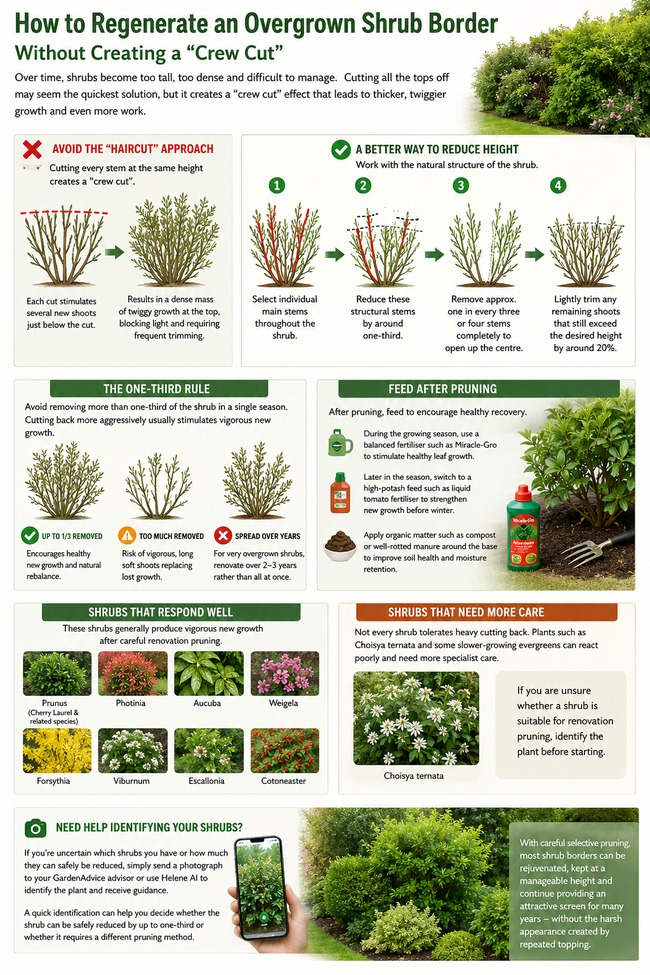
Simply trimming every stem across the top of a shrub border creates what gardeners often describe as a “crew cut” effect.
Each time a stem is cut, the plant responds by producing several new shoots just below the cut. Instead of one stem, you may end up with three or four new shoots. Over time this creates a dense mass of twiggy growth at the top of the hedge or shrub, making it even thicker and more difficult to maintain.
The result is a border that quickly becomes overcrowded, blocks light from reaching the lower branches, and requires increasingly frequent trimming.
A Better Way to Reduce the Height
A much more effective approach is to work with the natural structure of each shrub.
Rather than cutting every stem at the same height:
- Select individual main stems throughout the shrub.
- Reduce these structural stems by around one-third.
- Remove approximately one in every three or four stems completely to open up the centre of the plant.
- Finally, lightly trim any remaining shoots that still exceed the desired height by around 20%.
This selective pruning maintains the shrub’s natural shape, allows more light and air into the centre of the plant and encourages healthy new growth throughout the shrub rather than just at the top.
The One-Third Rule
As a general rule, avoid removing more than one-third of the shrub in a single season.
Cutting back more aggressively usually stimulates vigorous new growth, causing the shrub to replace the lost material quickly with long, soft shoots. By limiting pruning to around one-third, the plant is encouraged to rebalance itself naturally without producing excessive regrowth.
For very overgrown shrubs, it is usually better to spread renovation over two or three years rather than attempting everything at once.
Feed After Pruning
Once pruning is complete, give the shrubs a balanced feed to encourage healthy recovery.
During the growing season, a general-purpose fertiliser such as Miracle-Gro can help stimulate healthy leaf growth. Later in the season, switching to a high-potash feed such as liquid tomato fertiliser can help strengthen new growth before winter. Applying organic matter such as compost or well-rotted manure around the base of the shrubs will also improve soil health and moisture retention.
Which Shrubs Respond Well?
Many common garden shrubs respond very well to this method of selective renovation, including:
- Prunus (Cherry Laurel and related species)
- Photinia
- Aucuba
- Weigela
- Forsythia
- Viburnum
- Escallonia
- Cotoneaster
These shrubs generally produce vigorous new growth after careful renovation pruning.
Shrubs That Need More Care
Not every shrub tolerates this style of pruning.
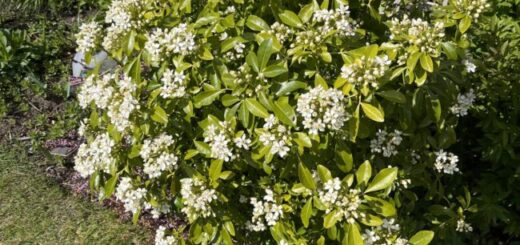
Plants such as Choisya ternata and some slower-growing evergreen shrubs can react poorly to heavy cutting back and may require more specialised pruning techniques or lighter renovation over several years.
If you are unsure whether a shrub is suitable for renovation pruning, identify the plant before starting.
Need Help Identifying Your Shrubs?
If you’re uncertain which shrubs you have or how much they can safely be reduced, simply send a photograph to your GardenAdvice advisor or use Helene AI to identify the plant and receive guidance. A quick identification can help you decide whether the shrub can be safely reduced by up to one-third or whether it requires a different pruning method.
With careful selective pruning, most shrub borders can be rejuvenated, kept at a manageable height and continue providing an attractive screen for many years without the harsh appearance created by repeated topping.