Streamside Cottage Garden Border – Design & Construction Notes
Illustration Guide
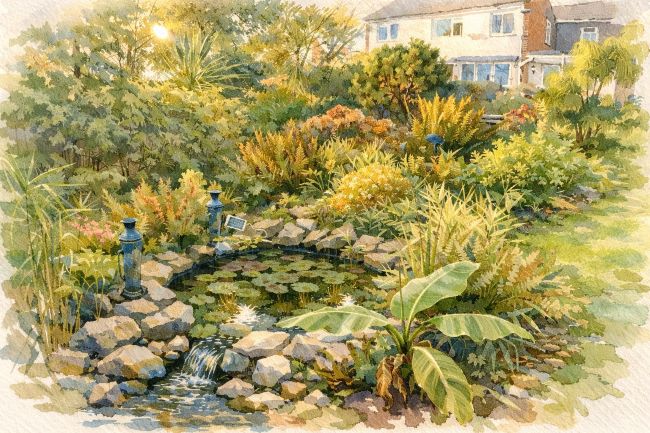
- Illustration 1
Shows the existing border looking up towards the house, with some of the grasses partially removed or thinned.
This highlights the underlying structure of the border and shows how reducing the dominance of grasses immediately lightens the planting and opens the space.
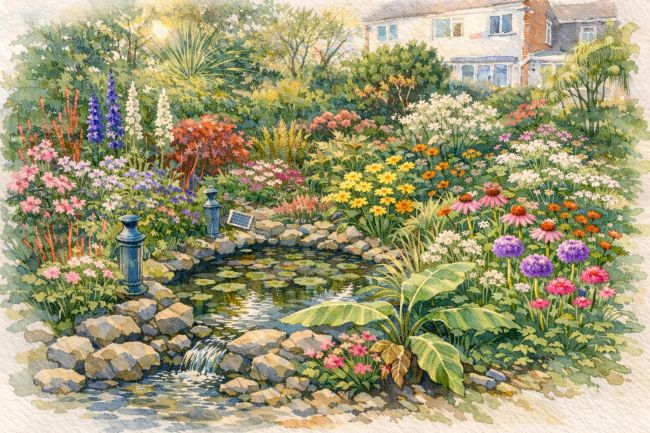
- Illustration 2
Again looking up towards the house, this image shows the border with the suggested plants introduced into the existing structure, creating a fuller cottage-style planting with strong mid-summer colour while still retaining the character of the original garden.
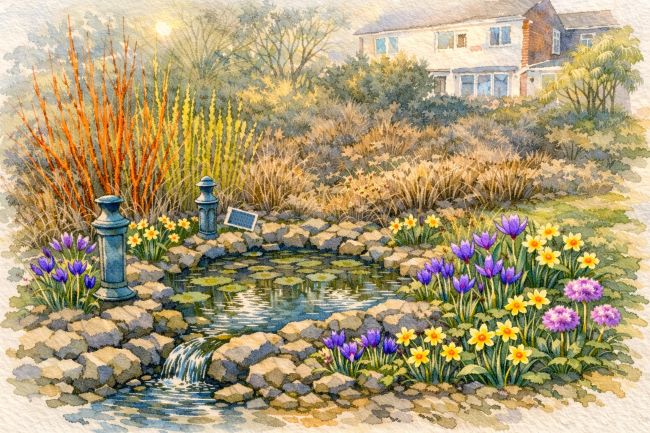
- Illustration 3
Looking up towards the house, this view shows the border in early spring, with seasonal interest provided by crocus, dwarf daffodils and Cornus stems (including Cornus ‘Sibirica’), demonstrating how the garden remains attractive well before the main growing season begins.
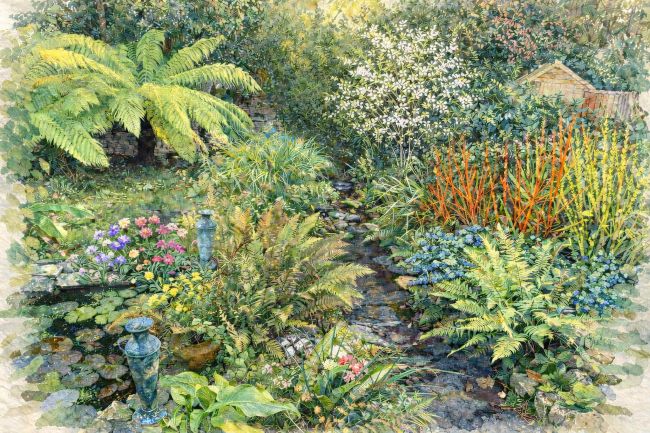
- Illustration 4
Looking down the border from the house along the path in early Spring, this image shows the proposed Amelanchier canadensis planted on the right-hand side, helping to screen the neighbouring shed.
It also highlights early spring colour from primulas and continued winter interest from Cornus stems.
Design Overview
This planting scheme has been designed to enhance the natural character of the stream while introducing a soft cottage-garden feel, improved screening, and strong year-round interest.
The design works with the existing garden, retaining key plants where possible, while selectively thinning or removing others to create a lighter, more flower-rich border.
The site sits on wet loam in full sun, which has informed both the plant selection and the ground preparation strategy.
Dealing with Wet Ground – Ground Preparation Strategy
Rather than attempting to drain the area, the design embraces the natural moisture levels by building up soil levels to lift plants slightly above the wettest ground.
Approach:
- Borders are gently raised without hard edging
- Existing soil is built up using:
- Mushroom compost
- Organic matter and soil improvers
- Reused garden materials where appropriate
This creates the effect of raised borders, but in a natural, flowing way that blends into the landscape.
Benefits:
- Plants are lifted out of prolonged waterlogging
- Roots still have access to consistent moisture
- Improved soil structure and fertility
- Borders look natural, not engineered
Overall Design Principles
- Informal cottage-style planting
- Plants arranged in loose drifts, not rigid blocks
- Strong seasonal succession
- Improved screening of the neighbouring shed
- Retention of existing planting where possible
- Selective thinning of grasses
- Clear visual connection with the stream
The aim is to move the border away from a grass-dominated look and towards a softer, flower-led cottage aesthetic.
Right-Hand Side of the Path Looking Towards House
(Closest to the stream – softer, flower-rich planting)
This side of the border focuses on early spring colour, soft foliage and plants that naturally enjoy damp conditions close to water.
Key Plants
- Primula denticulata – spring structure, great near water
- Primula candelabra (e.g. P. japonica, P. beesiana) – perfect for damp soil
- Rudbeckia (R. fulgida, R. laciniata) – late-summer warmth
- Echinacea purpurea – height, seedheads, wildlife value
- 🌼 Additional plants to strengthen the cottage look
- Spring–Early Summer
- Aquilegia vulgaris – self-seeding, light and airy
- Caltha palustris (Marsh marigold) – early colour close to water
- Brunnera macrophylla – soft foliage, spring blue flowers
- Geranium pratense – long flowering, excellent filler
- Mid–Late Summer
- Astilbe – loves moisture, feathery contrast
- Filipendula rubra / ulmaria – perfect for wet ground, very cottagey
- Helenium – warm colours echo Rudbeckia
- Persicaria amplexicaulis – long flowering, great near water
- Monarda – bold colour, pollinator magnet
- Autumn Interest
- Aster (Symphyotrichum) – late nectar and softness
- Thalictrum – delicate flowers over bold foliage
These plants create a soft transition from water to path, with flowers appearing early in the year when much of the rest of the garden is still waking up.
Left-Hand Side of the Path Looking Towards House
(Structural backbone, winter colour and screening)
The right-hand side provides the framework of the border, with strong winter interest and taller elements to balance the more delicate planting near the stream.
Structural Shrubs
- Cornus ‘Midwinter Fire’ – Multi-stem shrub with fiery orange and red winter stems, providing strong colour from late autumn through early spring.
- Cornus stolonifera ‘Flaviramea’ – Bright yellow-green winter stems that contrast beautifully with ‘Midwinter Fire’, planted at the same height to create a unified effect.
- Brunnera macrophylla – Softens the base of the Cornus while allowing the coloured stems to remain visible.
- Phlox paniculata – classic cottage plant
Euonymus alatus – excellent autumn colour
Cornus (winter stems) – strong winter structure
🌳 Structural & Taller Perennials
Delphinium – classic cottage verticals
Digitalis purpurea – early height and softness
Actaea simplex (formerly Cimicifuga) – late-season drama
Angelica archangelica – architectural, self-seeding elegance
Veronicastrum virginicum – tall but refined
🌾 Grasses (use sparingly for movement)
Molinia caerulea – very elegant near water
Deschampsia cespitosa – light, airy, naturalistic
Miscanthus ‘Morning Light’ – for late-season glow (use as punctuation)
🌱 SHRUB & BACKBONE PLANTS (LEFT SIDE)
Cornus alba ‘Sibirica’ or ‘Kesselringii’ – winter colour
Euonymus alatus – autumn fire
Hydrangea arborescens / paniculata – summer to autumn bulk
Viburnum opulus – flowers, berries, seasonal interest
The Cornus are planted in groups but not too densely, allowing the coloured stems to remain visible and effective in winter
Screening the Neighbouring Shed
Screening is focused on the shed to the right-hand side of the garden.
- Amelanchier canadensis (multi-stem, approx. 1.6m at planting)
Positioned further up the border, this provides light, natural screening while contributing seasonal interest through blossom, foliage and structure.
Working With Existing Planting
The scheme is designed to integrate with existing plants, not replace them wholesale.
- Some grasses are thinned or removed
- Remaining grasses are used sparingly
- Existing shrubs are retained where appropriate
- New planting is woven through to create a cohesive whole
Seasonal Interest Summary
Early Spring
- Crocus, dwarf daffodils, Iris reticulata
- Primula denticulata
- Caltha palustris
- Brunnera flowers
- Cornus winter stems
Late Spring – Early Summer
- Primula candelabra
- Aquilegia vulgaris
- Amelanchier blossom
Summer
- Lush foliage structure
- Streamside planting at full volume
Autumn
- Amelanchier autumn colour
- Texture from dying back perennials
Winter
- Cornus ‘Midwinter Fire’ and ‘Flaviramea’ stems
- Clear structure of shrubs and tree forms
Final Note
The finished border will feel natural, relaxed and well-established, while being practical for a wet site and visually cohesive with the rest of the garden.