
Border Design & Planting Notes
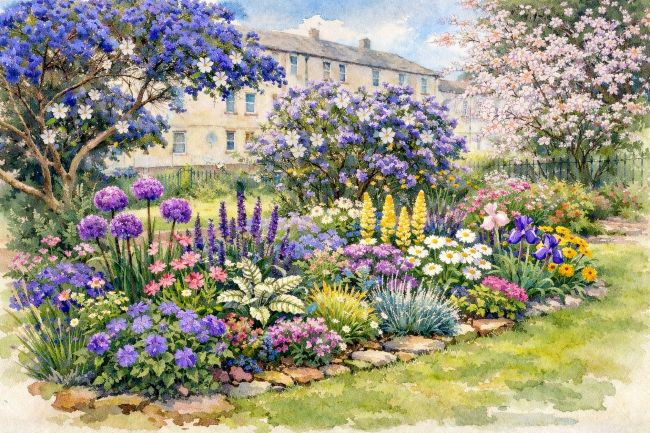
The illustrated views show the proposed development of the existing border beneath the Ceanothus, extending it further into the lawn to create a richer, more layered planting scheme with interest throughout the year.
Ceanothus & Climbers
Within both existing Ceanothus shrubs, we have introduced Clematis ‘Jackmanii Alba’. This is a light, non-dominant climber which will weave gently through the shrubs rather than smothering them. Its fresh white flowers will appear later in the season, adding an extra layer of colour and extending interest beyond the Ceanothus flowering period.
In the far right-hand corner, a Prunus × subhirtella ‘Autumnalis’ (winter-flowering cherry) has been added. This small tree provides structure and height, while also delivering delicate blossom during the winter and early spring months, giving the garden interest at a time when little else is flowering.
Border Extension & Layout
The border has been extended by approximately 500 mm into the lawn, with a deliberately irregular edge to soften the transition between lawn and planting. This additional depth allows for better layering, helping the planting feel more immersive and natural while improving seasonal impact.
Where the washing line enters the border, existing slabs can be reused as informal stepping stones, allowing access to the end of the washing line without compacting soil or disrupting planting. These can be subtly integrated and softened with surrounding plants.
Soil Preparation & Establishment
As this area has been recently cleared, soil preparation will be important to ensure successful establishment. At this stage, the soil should be lightly forked, incorporating chicken pellets and a general-purpose fertiliser. Once planting is complete, a mulch applied later in the season will help retain moisture, suppress weeds, and support strong early growth.
Planting Palette & Descriptions
The border uses a balanced mix of structure, movement, and long-flowering perennials to provide interest from spring through to autumn.
Allium ‘Purple Rain’
Large, rounded purple flower heads held on tall stems in early summer. Adds height and drama above lower planting and is excellent for pollinators.
Salvia ‘Caradonna’
Upright spikes of deep violet flowers from late spring through summer. Provides strong vertical structure and contrasts well with softer plants.
Salvia greggii ‘Salmon Dance’
A long-flowering, shrubby salvia with warm salmon-pink flowers. Very attractive to bees and reliable for colour well into autumn.
Aster × frikartii ‘Mönch’
Lavender-blue daisy flowers appearing in late summer and early autumn. Essential for extending the flowering season.
Geranium ‘Johnson’s Blue’
A low, spreading perennial with clear blue flowers in early summer. Excellent groundcover that helps knit the planting together.
Geranium ‘Rozanne’
Exceptionally long-flowering, with violet-blue flowers from early summer through autumn. Ideal for softening edges and filling gaps.
Phlox ‘Clouds of Perfume’
Light pink, delicately scented flowers held above fresh green foliage. Adds fragrance and softness to the middle of the border.
Leucanthemum ‘Goldfinch’
Soft yellow daisy-like flowers that fade gently to cream. Brings a relaxed, meadow-like feel and brightens early summer planting.
Artemisia lactiflora ‘Guizhou’
Elegant, airy plumes of creamy white flowers in late summer. Adds height and movement without heaviness.
Iris sibirica ‘Sparkling Rose’
Graceful pink flowers above fine, upright foliage in early summer. Introduces a refined vertical accent.
Iris t.b. ‘Imperator’
A bold bearded iris with strong architectural presence and rich colouring. Provides early summer impact and contrast.
Erysimum ‘Bowles’s Mauve’
Evergreen foliage with soft mauve flowers over a very long season. Excellent for continuity of colour and structure.
Acanthus ‘Whitewater’
Large, dramatic foliage with tall flower spikes in summer. Anchors the border and provides architectural interest.
Lupin Gallery ‘Yellow’
Upright spires of yellow flowers in late spring to early summer. Adds early colour and strong vertical rhythm.
Rudbeckia ‘Goldsturm’
Bright golden-yellow flowers with dark centres from mid-summer into autumn. A reliable plant for strong late-season colour.
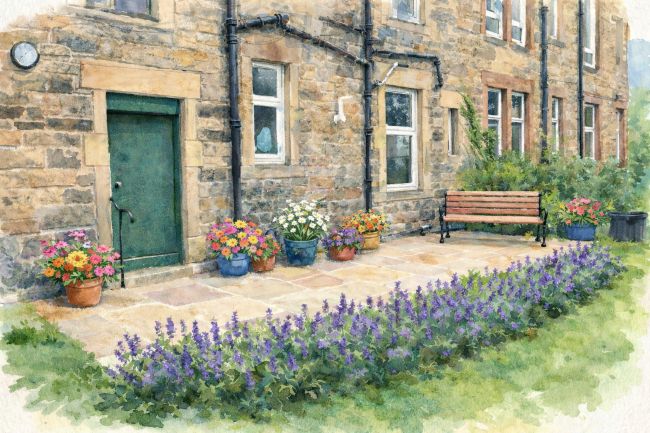
Patio & Hedge Recommendation (Second Image)
In the image showing the new patio, a salvia hedge is recommended in place of lavender. While lavender can initially look attractive, even when maintained as a thin hedge it quickly becomes woody and difficult to keep looking neat.
Salvia, by contrast, dies back naturally each year, is cut back annually, and regrows cleanly, providing a long flowering season and a more reliable, softer structure. This makes it a more sustainable and visually consistent choice for this location.