Creating Winter Interest with Autumn Colour and Cornus Stems
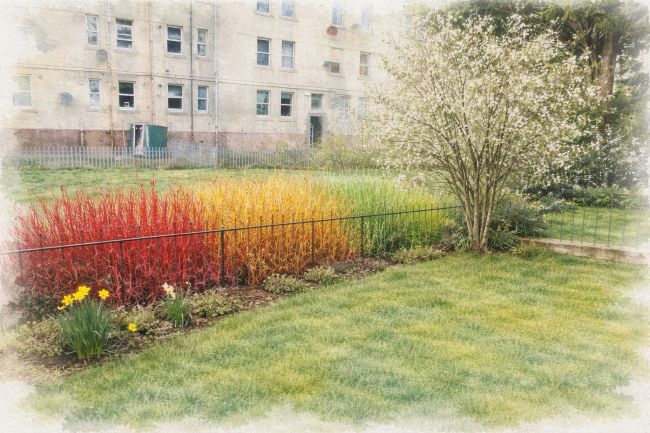
Designing a garden that carries interest through the colder months is all about planning layers of seasonal impact. One effective approach is to combine strong autumn colour with vibrant winter stems, creating a seamless transition from one season to the next.
A great example of this is using Amelanchier which produces outstanding red and yellow autumn colour. As the leaves turn and eventually fall, they create a warm seasonal display before revealing the structure beyond.
Positioned on the far side of a fence, Cornus (dogwood) can then take over as the main feature. These are particularly effective when planted in bold groups or blocks, with different varieties chosen for their contrasting stem colours. As the perennials in front of the fence die back in late autumn, the colourful stems of the Cornus are gradually revealed, bringing the garden to life through winter.
In spring, the Cornus should be hard pruned to encourage fresh, brightly coloured stems for the following winter. At the same time, the planting in front—typically herbaceous perennials such as agapanthus and phlox—begins to regrow, softening the space and shifting the focus back to flowers and foliage for the warmer months.
This layered approach creates a dynamic cycle: autumn colour from Amelanchier, winter structure and vibrancy from Cornus, and summer interest from perennials.
Recommended Cornus Varieties for Stem Colour
- Cornus alba ‘Sibirica’ – vivid bright red stems
- Cornus alba ‘Elegantissima’ – red stems with variegated foliage
- Cornus sanguinea ‘Midwinter Fire’ – fiery mix of yellow, orange, and red
- Cornus sericea ‘Flaviramea’ – striking lime-green stems
- Cornus sanguinea ‘Anny’s Winter Orange’ – strong orange winter colour
Planting these in blocks or drifts enhances their visual impact, especially when viewed from a distance.
Propagation Tip
Cornus are also incredibly easy to propagate from hardwood cuttings taken in winter, making them a cost-effective choice for larger planting schemes. For a step-by-step guide, see GardenAdvice page on taking hardwood cuttings.