
Possible identification: , commonly called
6 October 2026
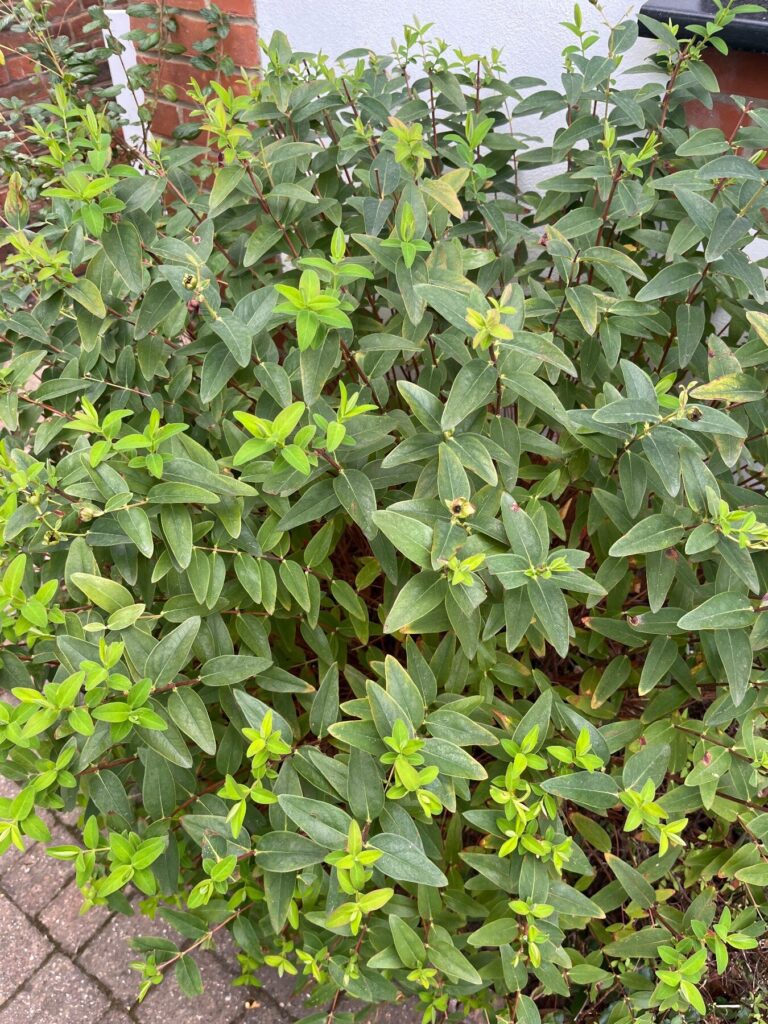
The **second photo looks like Hypericum**, commonly called **St John’s wort** — most likely a shrubby type such as **Hypericum ‘Hidcote’** or a similar variety.
### Why I think it’s Hypericum
The clues are:
- **Opposite pairs of narrow oval leaves**
- **Fresh lime-green new shoots**
- **Reddish-brown stems**
- Small round **spent flower/seed capsules**
- It’s an evergreen/semi-evergreen shrub commonly grown near houses and paths
It would usually have **bright yellow, open, saucer-shaped flowers** in summer.
The **first photo** looks like a mixture of tangled climber growth — probably your **Clematis montana** — growing through or over other planting, rather than the Hypericum itself.
## What to do with the Hypericum now
In early October, I’d keep it fairly simple:
### 1. Remove dead or scruffy growth
Cut out:
- Dead brown stems
- Crossing stems
- Any damaged or diseased shoots
- Old flower/seed heads if you want it tidier
This improves airflow and keeps the shrub looking healthy.
### 2. Lightly shape it
You can trim back any shoots that are flopping over the path or getting too large. Don’t worry — Hypericum is quite forgiving.
### 3. Save harder pruning for spring
If it’s become too big, woody, or bare in the middle, do the main prune in **spring**, after the worst frosts. You can cut it back by about **one third**, or harder if you need to renovate it.
Spring pruning works well because Hypericum responds by producing fresh new growth, which then flowers later in the season.
## If it has yellowing leaves
A few yellow leaves at this time of year are normal. But if it is very yellow, the common causes are:
- Dry soil near walls or paving
- Poor soil
- Waterlogging
- Lack of feed
- Congestion from climbers growing through it
In spring, give it a mulch of compost and a general feed to encourage stronger growth.
So: **yes, the leafy shrub is most likely Hypericum / St John’s wort.** Tidy it now, but leave any major reshaping until spring.