
What are these ceilings I think they’re from date seeds where we’ve eaten dates and thrown the stones into the garden
6 October 2026
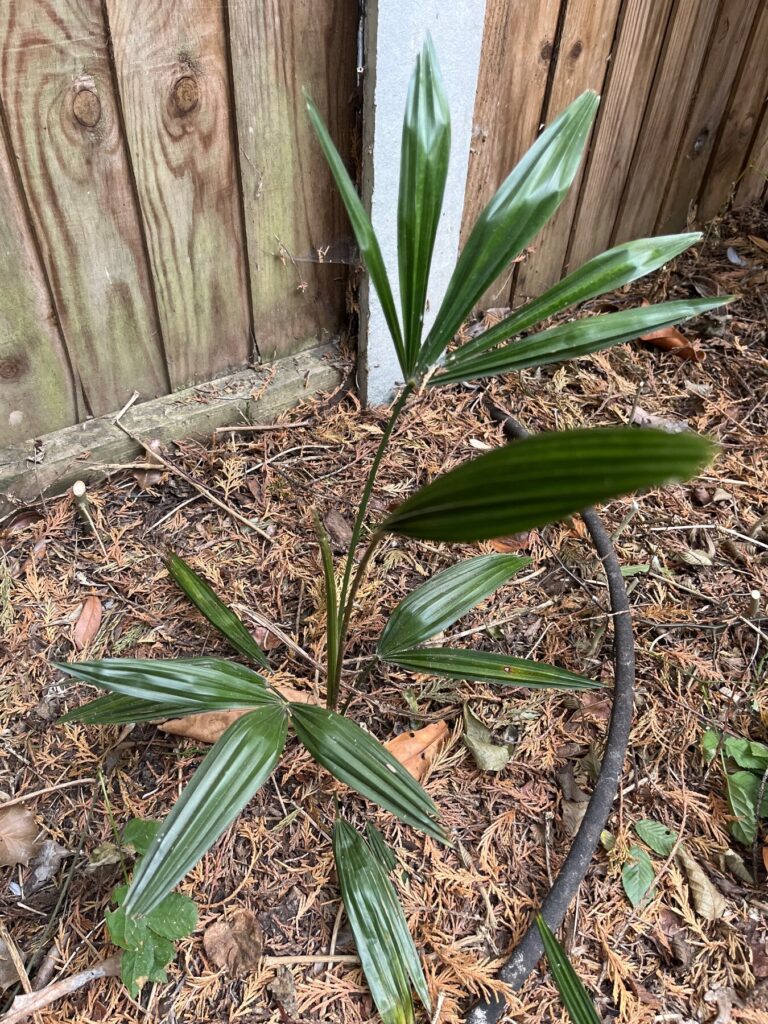
Yes — the plant in the **last photo** is definitely a **palm seedling**, but I don’t think it’s a **date palm**.
It looks much more like a young **fan palm**, most likely **Trachycarpus fortunei**, commonly called **Chusan palm** or **windmill palm**.
## Why it’s probably not a date palm
Date palms — **Phoenix dactylifera** — usually start with long, narrow, strap-like leaves and later develop feather-like fronds.
Your seedling has **pleated, fan-shaped leaves**, which points much more towards a **fan palm**, especially Trachycarpus. These often self-seed in UK gardens if there is a mature palm nearby.
So unless you’ve definitely thrown date stones exactly there, I’d say this is more likely to have come from a nearby ornamental palm seed than from dates you’ve eaten.
## Is it worth keeping?
Yes, if you like palms. **Trachycarpus fortunei is one of the hardiest palms for UK gardens** and can eventually make a lovely architectural plant.
However, I’d move it from where it is now because it looks close to a fence/wall. Given time, it will want space.
## What to do now in October
### If you want to keep it:
- Carefully lift it with as much root as possible.
- Pot it into a deep pot, as palms often make surprisingly long roots when young.
- Use a free-draining compost — peat-free multipurpose mixed with some grit/perlite is fine.
- Keep it sheltered over winter, ideally against a wall, in a cold greenhouse, or somewhere frost-protected.
- Keep it just lightly moist, not wet.
Then plant it out in spring or early summer when the soil is warming.
### If you leave it in the ground:
- Add a light mulch around it, but don’t bury the stem.
- Protect it with fleece if hard frost is forecast.
- Avoid waterlogging over winter.
## What about the other photos?
Just to recap from your photos:
- **Photo 1:** Hypericum / St John’s wort
- **Photo 2:** Tulbaghia violacea / society garlic
- **Photo 3:** Your heat-scorched low hedge, likely Euonymus
- **Photo 4:** Drought-stressed lawn
- **Photo 5:** Young palm seedling, likely Trachycarpus fortunei
So the “seedlings” you’re seeing are not likely to be date palms — they’re probably **self-sown hardy palm seedlings**. If there’s a mature palm anywhere nearby, that would explain it.