
Rhododendron notes
6 October 2026
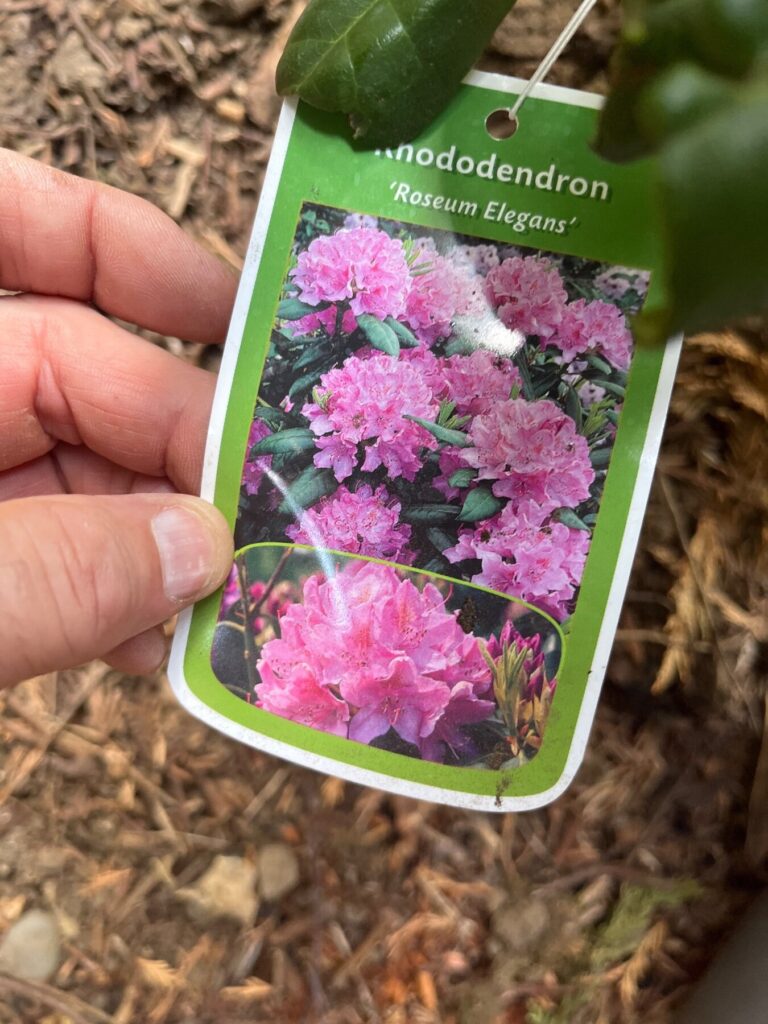
Yes — I can make clear after-care notes for them. From the label, the rhododendron is:
## Rhododendron ‘Roseum Elegans’
This is a **large, evergreen rhododendron** with rounded trusses of **pink to lilac-pink flowers**, usually in **late spring to early summer**, around **May–June** in the UK.
One quick note: the **second photo is not a rhododendron** — that looks like a young **palm seedling**, probably *Trachycarpus fortunei*. But assuming the three newly planted shrubs are all labelled **Rhododendron ‘Roseum Elegans’**, here are the notes.
---
# Expected size
## Rhododendron ‘Roseum Elegans’
- **After 5 years:** roughly 1–1.5m high and wide
- **After 10 years:** around 1.8–2.5m high and wide
- **Long-term mature size:** potentially **3m+ high and wide** in good conditions
It is not a tiny dwarf rhododendron — it becomes a substantial rounded shrub. If planted close together, they will eventually merge into one large evergreen mass, which can be very effective if that is the intention.
If you want to keep them more compact, they can be lightly shaped, but rhododendrons are best not clipped like a hedge.
---
# Best position
Rhododendrons like:
- **Partial shade**
- Shelter from cold drying winds
- Moist but free-draining soil
- Acid soil, ideally around **pH 4.5–5.5**
- A woodland-style mulch around the roots
They do not like hot, dry, reflective positions or alkaline soil. If they are near walls, paving, mortar, or concrete, keep an eye on leaf colour because lime can make the soil more alkaline.
---
# Very important: planting depth
Rhododendrons are **shallow-rooting plants**.
They should be planted so the top of the rootball is **level with, or just slightly above, the surrounding soil**.
Do not bury the stem or plant them too deeply. Deep planting is one of the most common reasons rhododendrons struggle.
---
# Watering after planting
This is the most important after-care job.
For the first **12–18 months**, water during dry spells, even if the weather feels mild.
### Watering guide
- Give each plant a deep soak rather than a light sprinkle.
- In dry autumn or spring weather, water once a week.
- In hot summer weather, water two or three times a week if needed.
- Rainwater is best if available, especially in hard-water areas.
Rhododendrons form flower buds in summer for the following spring. If they dry out badly in summer, they may survive but fail to flower well the next year.
---
# Mulching / top dressing
Mulch them every year.
Use one of the following:
- Ericaceous compost
- Leaf mould
- Composted bark
- Pine needle mulch
- Well-rotted acidic organic matter
Apply a mulch about **5–8cm deep** around each plant, but keep it away from the main stem.
### Avoid:
- Mushroom compost
- Garden lime
- Fresh manure
- Heavy alkaline composts
- Ash from fires
Mushroom compost is usually too alkaline for rhododendrons, so don’t use it around these plants.
A good annual mulch matters because rhododendrons naturally grow in woodland leaf litter. Their roots sit near the surface and feed from the organic layer above them.
---
# Feeding
Use an **ericaceous feed**, not a normal general-purpose feed if your soil is not naturally acidic.
### Best time to feed
- **Early spring**, just as growth starts
- Optional second light feed **after flowering**
Do not feed heavily late in the year, because soft new growth can be damaged by frost.
If the leaves go pale yellow with green veins, that often means the plant cannot access iron because the soil is too alkaline. In that case, use an **ericaceous feed** and possibly a **sequestered iron tonic**.
---
# Pruning
Rhododendron ‘Roseum Elegans’ needs very little pruning.
### Best time to prune
Prune **immediately after flowering**, usually in late May or June.
### What to remove
- Dead wood
- Damaged shoots
- Crossing branches
- Any stems growing the wrong way
Avoid pruning in autumn or winter because you may remove next year’s flower buds.
If you want to deadhead after flowering, you can carefully snap off the faded flower trusses, but don’t damage the new shoots just below them.
---
# First-year care checklist
## Now, in October
- Water them in well.
- Check they are not planted too deeply.
- Mulch with ericaceous compost, leaf mould, or composted bark.
- Do not feed heavily now.
- Remove weeds around the root area by hand.
## Winter
- Leave them alone unless they become dry.
- In very dry winter weather, water occasionally.
- Avoid piling mulch against the stems.
## Spring
- Apply ericaceous feed.
- Top up mulch.
- Water in dry spells.
- Check for healthy new growth and flower buds.
## After flowering
- Deadhead if practical.
- Lightly prune only if needed.
- Give a light ericaceous feed if growth looks weak.
## Summer
- Keep watered in dry spells.
- This is when next year’s flower buds are forming, so drought stress at this stage can reduce flowering.
---
# Note on the palm seedling in your photo
The plant in the second photo looks like a young **Trachycarpus palm**, not a rhododendron. It has pleated, fan-like leaves. If you want to keep it, I’d move it to a pot or a more open position because it will eventually become a small palm tree.
---
## Summary note
**Rhododendron ‘Roseum Elegans’** is a large, hardy evergreen rhododendron with pink-lilac flowers in late spring. Expect around **2m in 10 years** and potentially **3m or more long term**. Keep the soil acidic, moist and well mulched. Feed with ericaceous fertiliser in spring, avoid lime and mushroom compost, and only prune lightly after flowering.