
Rhododendron Cunningham’s white
6 October 2026
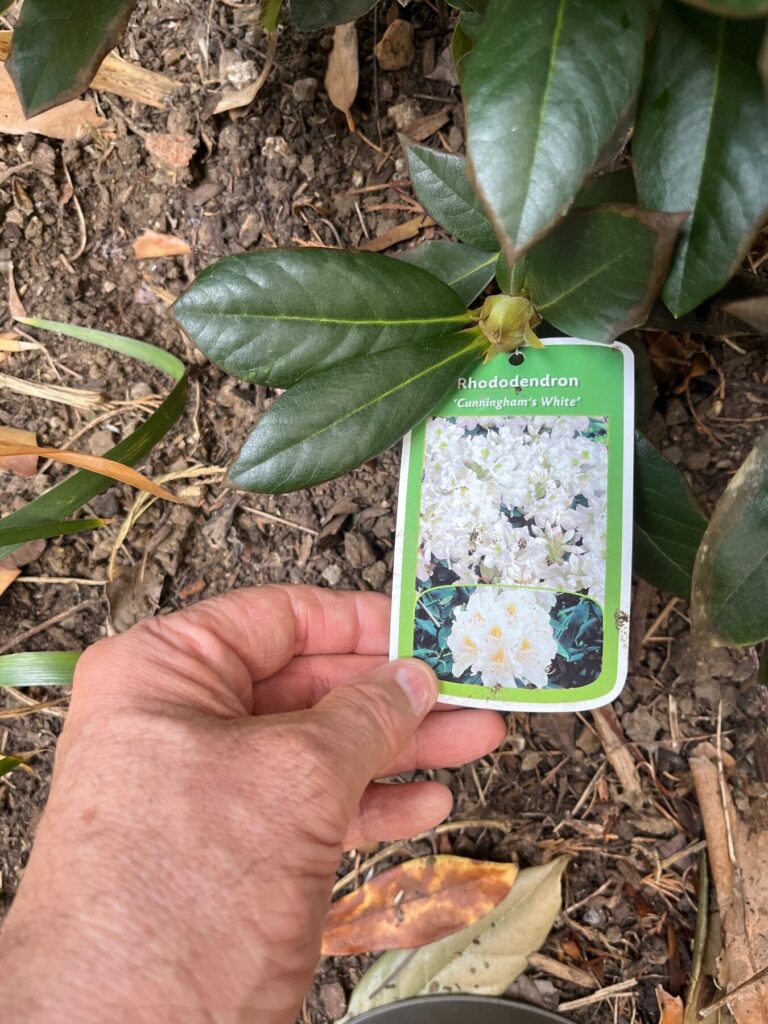
Yes — here are clear notes for the newly planted **rhododendrons** in this bed, including expected mature size and after-care.
From the labels/photos, you have planted:
1. **Rhododendron ‘Roseum Elegans’** — pink/lilac-pink flowers
2. **Rhododendron ‘Cunningham’s White’** — white flowers
3. **Rhododendron ‘Nova Zembla’** — red/crimson flowers
The small palm seedling in one photo is separate — likely a young **Trachycarpus fortunei / Chusan palm**.
---
# Newly Planted Rhododendron Bed — Notes
## General position and conditions
The rhododendrons appear to be planted in a sheltered border near fencing/shrubs, with some natural leaf/conifer needle mulch already present. That can be a good position because rhododendrons like **shelter, dappled shade and cool roots**.
However, fence-line borders can also become **very dry**, so watering will be the most important after-care job during establishment.
Rhododendrons need:
- **Acidic soil**
- Moist but free-draining conditions
- Partial shade or dappled light
- Shelter from drying wind
- A cool, mulched root run
They dislike:
- Lime
- Alkaline soil
- Mushroom compost
- Wood ash
- Dry rootballs
- Being planted too deeply
---
# 1. Rhododendron ‘Roseum Elegans’
## Flower colour
Pink to lilac-pink flower trusses.
## Flowering time
Usually **May to June**.
## Expected size
This is the largest of the three.
- **After 5 years:** around 1–1.5m high and wide
- **After 10 years:** around 1.8–2.5m high and wide
- **Long-term mature size:** potentially **3m or more** in good conditions
## Notes
This is a strong-growing, classic evergreen rhododendron. Give it enough room, as it can become quite a substantial shrub over time.
---
# 2. Rhododendron ‘Cunningham’s White’
## Flower colour
White flowers, often opening from pale pink buds.
## Flowering time
Usually **April to May**.
## Expected size
More compact than ‘Roseum Elegans’.
- **After 5 years:** around 1–1.2m high and wide
- **After 10 years:** around 1.5–2m high and wide
- **Long-term mature size:** around **2–2.5m**, sometimes larger
## Notes
This is one of the tougher and more reliable rhododendrons. It is a good choice if conditions are slightly less acidic than ideal, although it still performs best in acid soil.
---
# 3. Rhododendron ‘Nova Zembla’
## Flower colour
Bright red to crimson-red flowers.
## Flowering time
Usually **May to early June**.
## Expected size
Medium to large.
- **After 5 years:** around 1–1.2m high and wide
- **After 10 years:** around 1.5–2m high and wide
- **Long-term mature size:** around **2.5m or more** in good conditions
## Notes
A hardy, bold-coloured rhododendron. It gives strong spring colour and contrasts well with the white and pink varieties.
---
# Spacing note
If the three are planted fairly close together, they will eventually grow into one large evergreen group. That can look very good, but allow space for their mature spread.
As a guide:
- ‘Cunningham’s White’ and ‘Nova Zembla’: allow roughly **1.5–2m spread**
- ‘Roseum Elegans’: allow roughly **2–3m spread**
If they are close to a path, lawn edge or fence, expect to do light shaping in future.
---
# Very important: planting depth
Rhododendrons are **shallow-rooting plants**.
Check that each one is planted with the **top of the rootball level with, or just slightly above, the surrounding soil**.
Do not bury the stem. If planted too deeply, rhododendrons often struggle, yellow, or fail to establish properly.
---
# Watering after planting
This is the most important care point.
For the first **12–18 months**, water them during dry spells, even in autumn and spring.
## Watering guide
- Give each plant a **deep soak**, not a light sprinkle.
- Focus water around the original rootball.
- In dry weather, water once a week.
- In hot summer weather, water more often if needed.
- Use **rainwater where possible**, especially if your tap water is hard.
Rhododendrons form next year’s flower buds in summer. If they dry out in summer, they may survive but flower poorly the following spring.
If you have irrigation pipe nearby, make sure it is actually delivering water to the rootballs, not just the surface around them.
---
# Top dressing and mulching
Mulch every year, ideally in autumn or spring.
Good mulches for rhododendrons:
- Ericaceous compost
- Leaf mould
- Composted bark
- Pine needles
- Woodland-style acidic organic mulch
Apply a layer around **5–8cm deep** around each plant.
Keep the mulch a few centimetres away from the main stem so it does not sit wet against the bark.
## Avoid around rhododendrons
- Mushroom compost
- Garden lime
- Wood ash
- Fresh manure
- Builders’ rubble or mortar-contaminated soil
These can make the soil too alkaline.
---
# Feeding
Do not feed heavily now in October.
The priority now is establishment, watering and mulching.
## Best time to feed
Feed in **early spring**, just as growth starts.
Use an **ericaceous feed** suitable for:
- Rhododendrons
- Azaleas
- Camellias
- Heathers
You can give a second light feed **after flowering** if the plants look weak, but avoid feeding late in summer or autumn because it can encourage soft growth before winter.
---
# Pruning
Rhododendrons need very little pruning.
## Best time to prune
Prune **immediately after flowering**, usually May or June.
## What to remove
- Dead stems
- Damaged branches
- Crossing shoots
- Awkward growth spoiling the shape
Avoid pruning in autumn or winter because the flower buds for next spring are already present.
---
# Deadheading
After flowering, you can remove the old flower heads if practical.
Snap off the faded flower truss carefully, making sure not to damage the new shoots just below it.
Deadheading helps the plant put energy into growth and next year’s buds rather than seed production.
---
# Signs to watch for
## Yellow leaves with green veins
Usually means the plant cannot access iron, often because the soil is too alkaline.
Action:
- Use ericaceous feed
- Mulch with ericaceous compost or bark
- Water with rainwater if possible
- Consider sequestered iron if severe
## Brown leaf edges
Often caused by:
- Drought
- Dry wind
- Rootball drying out
- Too much sun
- Poor establishment
Action:
- Water deeply
- Mulch well
- Keep roots cool and moist
## Flower buds turning brown and not opening
Could be:
- Drought stress from the previous summer
- Frost damage
- Bud blast disease
Remove affected buds if seen.
---
# Care plan for October
For the newly planted rhododendrons, do this now:
1. **Check planting depth**
Rootball should be level or slightly proud.
2. **Water deeply**
Especially if the soil is dry under the surface.
3. **Apply ericaceous mulch**
Bark, leaf mould, pine needles or ericaceous compost.
4. **Do not feed heavily now**
Wait until spring.
5. **Do not prune now**
Leave flower buds intact.
6. **Keep weed-free**
Pull weeds by hand because rhododendron roots are shallow.
---
# Quick summary table
| Variety | Flower colour | Flowering time | Expected mature size |
|---|---|---|---|
| **Rhododendron ‘Roseum Elegans’** | Pink/lilac-pink | May–June | 2.5–3m+ |
| **Rhododendron ‘Cunningham’s White’** | White | April–May | 2–2.5m |
| **Rhododendron ‘Nova Zembla’** | Red/crimson | May–June | 2–2.5m+ |
Overall, this is a good combination: white, pink and red spring flowers with evergreen structure all year. The key to success will be **acidic mulch, no lime, correct planting depth and consistent watering while they establish**.