
Possible identification: Trachycarpus fortunei
6 October 2026
Yes — here are notes for the **newly planted rhododendrons at the rear of the barbecue area**.
From your labels, the planting includes:
1. **Rhododendron ‘Roseum Elegans’** — pink/lilac-pink flowers
2. **Rhododendron ‘Cunningham’s White’** — white flowers
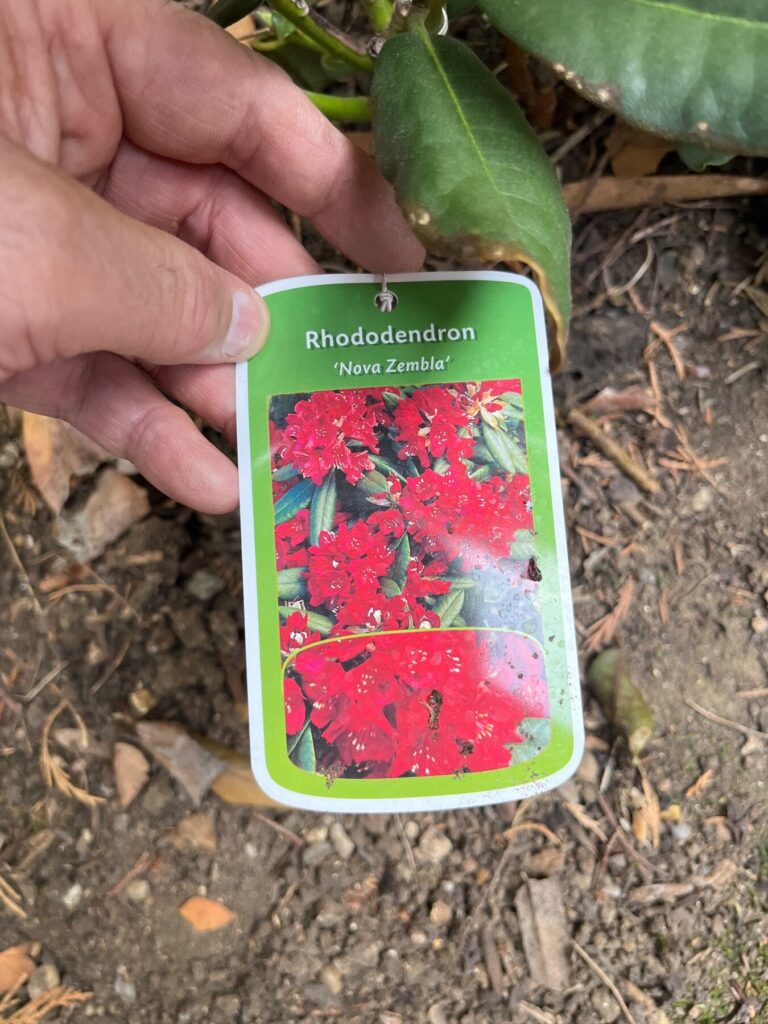
3. **Rhododendron ‘Nova Zembla’** — red/crimson flowers
Also, the palm-like seedling in the photo is **not a rhododendron** — it looks like a young **Trachycarpus fortunei**, also called Chusan palm or windmill palm.
---
# Rear Barbecue Area Rhododendron Planting Notes
## General description
This is a group of newly planted evergreen rhododendrons positioned near the rear/barbecue area. They should give a strong spring display in **white, pink and red**, while also providing evergreen structure throughout the year.
The area looks fairly sheltered, which is good, but because it is close to the house, fencing, paving and barbecue area, the soil may become **dry and warm** in summer. That means watering and mulching will be especially important while the plants establish.
Rhododendrons are shallow-rooting woodland shrubs, so they prefer cool, moist, acidic soil with plenty of organic matter.
---
# 1. Rhododendron ‘Roseum Elegans’
## Flower colour
Soft **pink to lilac-pink** flowers in rounded trusses.
## Flowering time
Usually **May to June** in the UK.
## Eventual size
This is the largest-growing of the three.
- **After 5 years:** about **1–1.5m high and wide**
- **After 10 years:** around **1.8–2.5m high and wide**
- **Long-term mature size:** potentially **3m or more** high and wide in good conditions
## Notes
This is a strong, traditional rhododendron. Allow space for it to spread over time. It will eventually become quite a substantial evergreen shrub.
---
# 2. Rhododendron ‘Cunningham’s White’
## Flower colour
White flowers, often opening from pale pink buds.
## Flowering time
Usually **April to May**.
## Eventual size
Usually a little more compact than ‘Roseum Elegans’.
- **After 5 years:** about **1–1.2m high and wide**
- **After 10 years:** around **1.5–2m high and wide**
- **Long-term mature size:** around **2–2.5m**, sometimes larger in ideal conditions
## Notes
This is one of the tougher and more reliable rhododendrons. It is slightly more tolerant than many varieties, but it still performs best in acidic, humus-rich soil.
---
# 3. Rhododendron ‘Nova Zembla’
## Flower colour
Bright **red to crimson-red** flowers.
## Flowering time
Usually **May to early June**.
## Eventual size
Medium to large.
- **After 5 years:** about **1–1.2m high and wide**
- **After 10 years:** around **1.5–2m high and wide**
- **Long-term mature size:** around **2.5m or more** in good conditions
## Notes
This is a bold, hardy red-flowering rhododendron. It will contrast nicely with the white and pink varieties.
---
# Overall spacing and long-term effect
If these three rhododendrons are planted fairly close together, they will eventually grow into one large evergreen group. That can look very attractive, especially at the rear of a seating or barbecue area, because it gives year-round structure and spring colour.
As a rough guide, allow:
- **‘Roseum Elegans’** — up to **2.5–3m spread**
- **‘Cunningham’s White’** — around **2m spread**
- **‘Nova Zembla’** — around **2–2.5m spread**
If they are close to a path, lawn edge or barbecue space, they may need light shaping in future.
---
# Important planting depth
Rhododendrons must not be planted too deeply.
The top of the rootball should be:
- Level with the surrounding soil, or
- Just slightly proud of the soil surface
They have shallow, fibrous roots that naturally sit near the surface. If planted too deeply, they can struggle, yellow, or fail to establish.
---
# Watering notes
This is the most important after-care task.
For the first **12–18 months**, water during dry periods, even in autumn and spring.
## Watering guide
- Water deeply rather than little and often.
- Focus water around the original rootball.
- In dry weather, water once a week.
- In hot weather, water more often if the soil dries.
- Rainwater is best if available, especially in hard-water areas.
Because this bed is near the house/barbecue area, the soil may dry out faster than it appears. Always check by pushing a finger into the soil near the rootball.
### Why watering matters
Rhododendrons form next year’s flower buds in summer. If they dry out badly in July or August, they may survive but flower poorly the following spring.
---
# Mulching and top dressing
Apply an acidic mulch every year, ideally in **autumn or spring**.
Good options include:
- Ericaceous compost
- Composted bark
- Leaf mould
- Pine needles
- Bracken compost
- Well-rotted manure, provided it is fully decomposed and not alkaline
Apply a layer about **5–8cm deep** around the plants, but keep it slightly away from the main stems.
## Avoid using
- Mushroom compost
- Garden lime
- Wood ash
- Fresh manure
- Builders’ rubble or mortar-contaminated soil
Mushroom compost is usually too alkaline for rhododendrons because it often contains lime.
---
# Feeding notes
Do not feed heavily now in October.
The priority now is to help the plants settle in with moisture and mulch.
## Best feeding time
Feed in **early spring**, just as growth starts.
Use an **ericaceous fertiliser** suitable for:
- Rhododendrons
- Azaleas
- Camellias
- Heathers
You can give a second light feed **after flowering** if growth looks weak, but avoid feeding late in summer or autumn because it can encourage soft growth before winter.
---
# Pruning notes
Rhododendrons need very little pruning.
## Best time to prune
Prune **immediately after flowering**, usually in **May or June**.
## What to remove
- Dead stems
- Damaged branches
- Crossing growth
- Awkward shoots growing into paths or seating areas
Avoid pruning in autumn or winter because next spring’s flower buds are already present.
---
# Deadheading
After flowering, you can remove old flower heads if practical.
Carefully snap off the faded flower truss without damaging the new shoots underneath. This helps the plant put energy into new growth and future flower buds rather than seed production.
---
# Signs to watch for
## Yellow leaves with green veins
This usually means the plant cannot take up iron, often because the soil is too alkaline.
### Action
- Mulch with ericaceous compost or bark
- Feed with ericaceous fertiliser in spring
- Water with rainwater where possible
- Consider sequestered iron if the yellowing is severe
## Brown leaf edges
This is often caused by:
- Drought
- Dry wind
- Rootball drying out
- Too much reflected heat from paving or walls
- Poor establishment
### Action
- Water deeply
- Mulch well
- Keep the root area cool and moist
## Buds turning brown and failing to open
Possible causes include:
- Drought the previous summer
- Frost damage
- Bud blast disease
Remove affected buds if they appear black or dead.
---
# Care notes for October
For the newly planted rhododendrons at the rear of the barbecue area, do the following now:
1. **Check planting depth**
Make sure the rootballs are not buried too deeply.
2. **Water thoroughly**
Especially if the soil is dry below the surface.
3. **Apply an acidic mulch**
Use ericaceous compost, leaf mould, pine needles or composted bark.
4. **Do not feed heavily now**
Wait until spring.
5. **Do not prune now**
Leave the flower buds intact for next spring.
6. **Keep the area weed-free**
Remove weeds by hand because rhododendron roots are shallow.
---
# Note on the palm seedling
The palm-like seedling shown in the photo is likely **Trachycarpus fortunei**, not a rhododendron.
If you want to keep it, I would consider moving it while still small, because it can eventually become a sizeable palm. If left in that narrow position near fencing or other shrubs, it may become awkward later.
---
## Summary
The rear barbecue area has been planted with three evergreen rhododendrons: **‘Roseum Elegans’**, **‘Cunningham’s White’** and **‘Nova Zembla’**. Together they should provide pink, white and red flowers from **April to June**, with evergreen structure all year. Long term, expect them to reach roughly **2–3m**, depending on variety and conditions. Their success will depend on **acidic soil, regular watering while establishing, annual acidic mulching, and avoiding lime or mushroom compost**.