
So this is a natural Lord Napier So Gonna make new growth next year that we need to throw in and it looks pretty healthy
6 October 2026
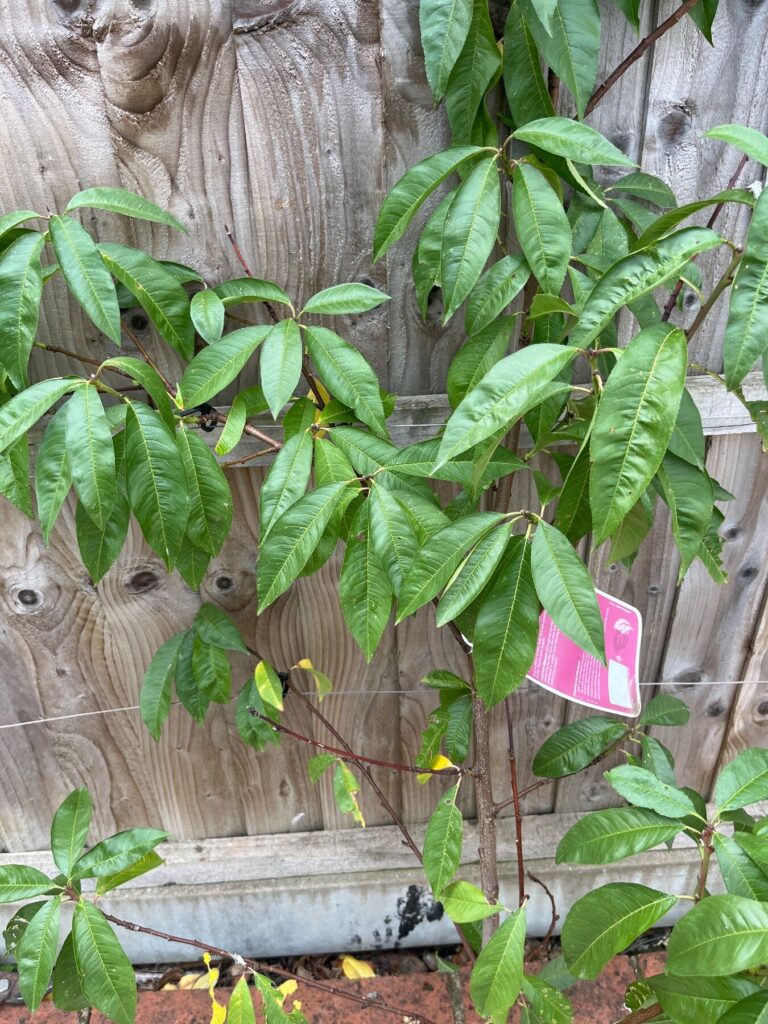
Yes — this looks like a **nectarine, probably ‘Lord Napier’**, trained or intended to be trained against the fence. It looks **healthy overall**: the leaves are a good green, the stems look alive, and it has already made some useful young shoots for training.
The first photo is still the **agapanthus seed head** — you can cut that flower stem off at the base now.
## Nectarine ‘Lord Napier’ — what to do now in October
### 1. Don’t expect new growth now
At this time of year the nectarine is naturally slowing down. It may start dropping leaves soon, and that is normal. You do **not** want to encourage soft new growth now because it would be vulnerable to frost.
So for now, the aim is:
- Help it settle in
- Keep it watered if dry
- Protect it from winter wet
- Prepare it for training next spring
---
## 2. Tie in the useful shoots
Because it is against a fence, the best way to grow it is as a **fan-trained nectarine**.
You already have horizontal wires, which is good. Tie the young stems loosely to the wires, spreading them out like a fan.
Use soft ties, not tight wire or string that could cut into the stems.
### Aim for:
- Main stems angled outwards from the centre
- Good spacing between shoots
- Plenty of air movement
- A balanced fan shape over time
Do not force stiff branches too far in one go. If a stem resists, tie it part-way and adjust it gradually next year.
---
## 3. Do not prune it hard now
Avoid heavy pruning in autumn and winter. Peaches and nectarines are prone to diseases such as **silver leaf and canker** if pruned in cold, wet weather.
### Best pruning time:
- **Spring to summer**, once growth is active
- Light pruning after flowering or during summer is much safer
For now, only remove anything that is clearly:
- Dead
- Broken
- Diseased
- Rubbing badly
Otherwise, leave it until spring.
---
## 4. Protect it from peach leaf curl
This is the big one with peaches and nectarines in the UK.
**Peach leaf curl** is a fungal disease encouraged by winter and early spring rain landing on the buds. It causes distorted, red, blistered leaves in spring.
Because your nectarine is against a fence, you can protect it quite easily.
### From late autumn to spring:
Try to keep rain off the branches and buds.
You can use:
- A temporary clear plastic rain cover
- A small lean-to cover against the fence
- Clear corrugated sheet
- Fleece in short cold spells, though plastic/rain cover is better for leaf curl prevention
The cover should allow air movement. Don’t wrap the tree tightly in plastic.
### When to cover:
Ideally from **November through to April**, especially during wet periods.
This matters because preventing winter rain on the buds is one of the best ways to reduce peach leaf curl.
---
## 5. Watering
Although it is autumn, newly planted fruit trees still need watering if conditions are dry.
Water at the base, deeply, rather than little and often.
For the first year:
- Water during dry spells
- Pay special attention in spring and summer
- Fence lines can be surprisingly dry because the fence and nearby paving/brickwork can create a rain shadow
Good watering next summer will also help the tree form fruit buds for the following year.
---
## 6. Mulch the base
Add a mulch around the root area, but keep it away from the trunk.
Good options:
- Well-rotted compost
- Leaf mould
- Composted bark
- Well-rotted manure
Apply about **5cm deep**, but leave a small gap around the stem so the bark does not stay wet.
Mulch helps keep the roots cool and moist, which is especially useful for a fruit tree planted against a fence.
---
## 7. Feeding
Do not feed strongly now.
### In spring:
Apply a general fertiliser such as **Growmore** around the root area, roughly a handful per square metre, then water it in.
### From fruit set onwards:
Use a **high-potash feed**, such as liquid tomato feed, every few weeks during the growing season. Potash helps with flowering and fruit development rather than just leafy growth.
Avoid too much high-nitrogen feed, because that can produce lots of soft leafy growth at the expense of fruit.
---
## 8. Training next year
Next spring and summer, you’ll select the best new shoots and tie them in to extend the fan.
The basic idea is:
- Keep the centre open
- Tie in strong young shoots to the wires
- Remove crowded inward-growing shoots
- Keep a balance between fruiting wood and replacement new growth
Nectarines fruit on younger wood, so you want a steady supply of new shoots each year.
---
## 9. Pollination and flowering
‘Lord Napier’ is generally considered self-fertile, so you don’t need another nectarine nearby.
However, because it may flower early when insects are scarce, you may get better fruit set by **hand-pollinating**.
When it flowers:
- Use a soft paintbrush
- Gently dab from flower to flower
- Do this on dry days if possible
If it is under a rain cover, hand pollination becomes more useful because fewer insects may reach the flowers.
---
## 10. Eventual size
If fan-trained against the fence, expect approximately:
- **Height:** around 2–2.5m
- **Width:** around 2.5–3m, depending on pruning and training
If left untrained, it could become a small tree around **3–4m**, but against the fence it should be managed as a fan.
---
## What it should be doing at the moment
Right now, in October, it should be:
- Slowing down
- Hardening its stems
- Preparing to lose leaves
- Settling its roots into the soil
So if it starts to yellow and drop leaves soon, don’t worry — that is normal autumn behaviour.
## Quick action list for now
1. Tie in the young stems loosely to the wires.
2. Do not hard prune now.
3. Water if the soil is dry.
4. Mulch the base, keeping mulch away from the trunk.
5. Plan a rain cover for winter to reduce peach leaf curl.
6. Feed in spring, not now.
Overall, it looks healthy. The main thing now is to **train it gently and protect it from winter rain**, so it starts strongly next spring.