
What is this plant and how do I care for it with regards to pruning and feeding
6 October 2026
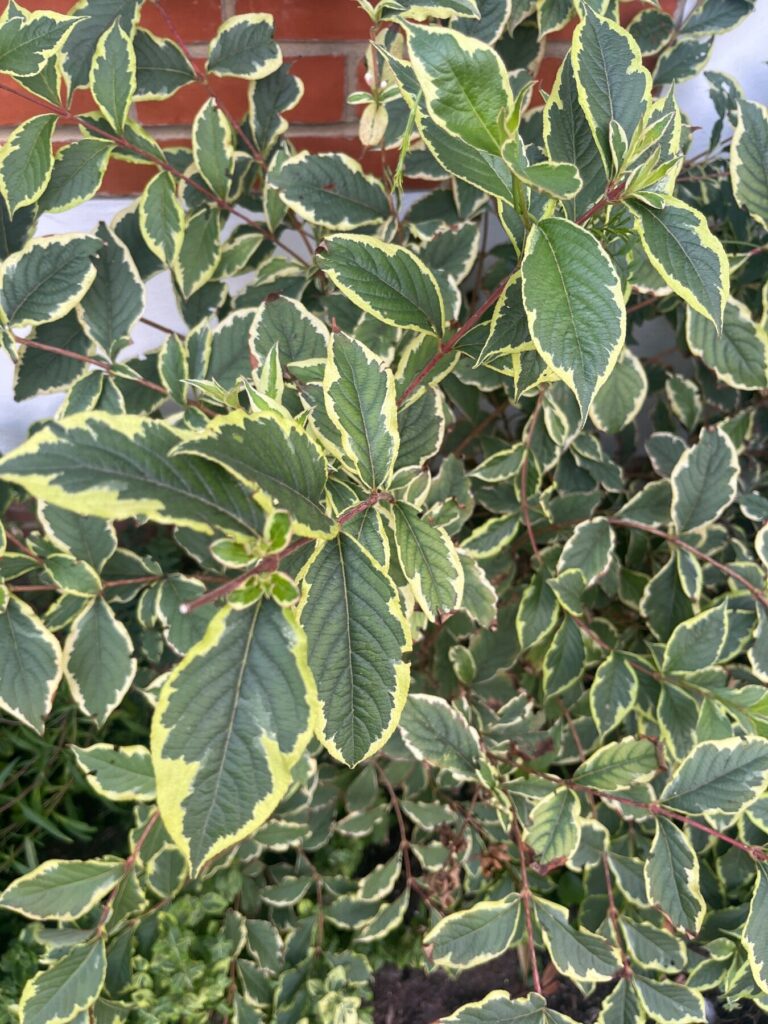
This is a **variegated dogwood**, most likely **Cornus alba ‘Elegantissima’** — sometimes sold as **variegated red-barked dogwood**.
It’s a deciduous shrub grown mainly for:
- **Cream-edged green leaves** in spring and summer
- **Red stems** in winter
- Small white flowers in late spring/early summer
- Sometimes white/blueish berries later in the season
It’s a good, tough UK garden shrub and very useful for winter colour.
---
## Expected size
If left unpruned, it can reach around:
- **Height:** 2–3m
- **Spread:** 2–3m
However, most people prune it regularly to keep it compact and to encourage the best red winter stems.
---
## Position
Dogwoods are quite adaptable, but they do best in:
- Full sun to partial shade
- Moist but not waterlogged soil
- Reasonably fertile ground
For the brightest winter stem colour, **more sun is better**. In deep shade it will grow, but the stems may be less colourful.
---
## Pruning
### Best time to prune
Prune in **late winter to early spring**, usually **February to March**, before the new leaves open.
I would **not prune it hard now in October**, because the red stems are part of its winter display and hard pruning now can encourage soft growth at the wrong time.
---
## How hard should you prune it?
You have two options.
### Option 1: Hard prune for strong red winter stems
Every year, or every other year, cut the stems down to about:
**15–30cm above ground level**
This is called coppicing. It encourages lots of fresh young stems, and those young stems have the strongest red colour the following winter.
This method keeps the plant smaller and more colourful.
### Option 2: Light prune for a larger shrub
If you want it to stay as a bigger screening shrub, don’t cut the whole plant down. Instead:
- Remove about **one third of the oldest stems** at the base each spring
- Take out dead, weak or crossing stems
- Shorten any long, wayward shoots
This keeps the shrub natural-looking while still encouraging new colourful stems.
---
## My recommendation for this plant
Looking at your photo, it looks healthy and fairly vigorous. I’d probably use the **one-third renewal method** unless you want it much smaller.
So in **February/March**:
1. Cut out the oldest, thickest stems near the base.
2. Remove any dead or damaged stems.
3. Shorten awkward shoots if they are growing into paths or other plants.
4. Leave some younger red stems to give winter colour.
If it becomes too large, then you can coppice it harder.
---
## Feeding
Feed in **spring**, not heavily now.
In March or April, apply a general fertiliser such as **Growmore** around the base — roughly **one handful per square metre** — and water it in if the soil is dry.
Then add a mulch afterwards.
Avoid overfeeding with high-nitrogen fertiliser, as that can produce lots of leafy growth but weaker stem colour.
---
## Mulching
Each spring, mulch around the base with:
- Garden compost
- Well-rotted manure
- Leaf mould
- Composted bark
Apply about **5cm deep**, but keep it slightly away from the main stems.
Mulching helps because dogwoods like a cool, moisture-retentive root run. It also improves the soil and reduces watering stress in summer.
---
## Watering
Once established, dogwoods are fairly tough. But if this is newly planted or growing near a wall/fence, water during dry spells.
In hot dry weather, give it a deep soak rather than little sprinkles. Dryness can cause leaf edge scorch, especially on variegated plants.
---
## Important: watch for plain green shoots
Variegated shrubs sometimes produce stronger plain green shoots. If you see any stems with **all-green leaves and no cream edge**, cut those shoots right out at the base.
Why?
The plain green growth is often more vigorous and can gradually take over the variegated plant.
---
## Quick care summary
- **Plant:** Variegated dogwood, likely *Cornus alba ‘Elegantissima’*
- **Size:** 2–3m high and wide if unpruned
- **Best feature:** Cream-edged foliage and red winter stems
- **Prune:** February/March
- **Feeding:** Growmore or general fertiliser in spring
- **Mulch:** Compost, bark or leaf mould in spring
- **Water:** During dry spells, especially if newly planted
- **Special care:** Remove any plain green reverted shoots
In short: it looks healthy. Leave it alone for now, enjoy the winter stems, then prune and feed it in early spring.