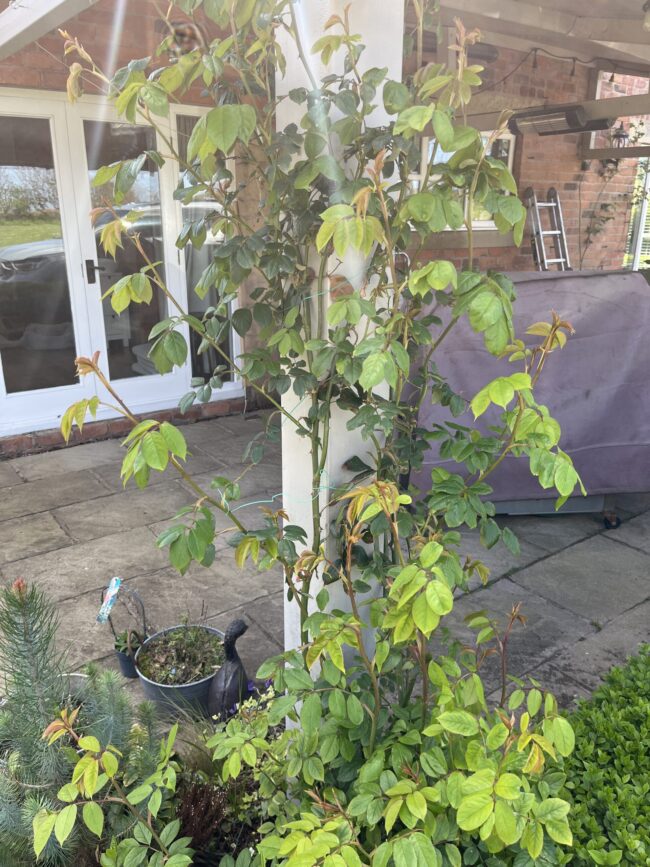
Training the the new growth on roses into the support system
The Importance of Training Climbing Roses for Maximum Flowering
Climbing roses are one of the most rewarding plants in the garden, capable of transforming walls, fences, arches, and trellis into spectacular displays of colour and scent. However, one of the most common mistakes people make is to treat climbing roses like ordinary shrubs—simply trimming the tops each year. This “haircutting” approach often results in tall plants with very little flowering lower down.
To get the very best from climbing roses, the key is not just pruning, but training—and in particular, training the stems horizontally.
Why “Haircutting Pruning” Doesn’t Work
When a climbing rose is allowed to grow straight upwards and is only trimmed at the top, the plant directs most of its energy into vertical growth. This is due to the plant hormone system (apical dominance), where growth hormones move rapidly to the highest point of the plant.
The result is:
- Strong vertical shoots
- Flowers concentrated at the top
- Bare, woody growth lower down
While the plant may still look healthy, it won’t deliver the full, even coverage most people are hoping for.
The Power of Horizontal Training
Training climbing roses so that their main stems are positioned horizontally or at a shallow angle dramatically changes how the plant behaves.


When stems are trained sideways:
- Growth hormones are distributed more evenly along the stem
- Dormant buds along the length of the stem are activated
- Each bud produces a flowering side shoot
This means instead of a few flowers at the top, you get:
- Multiple flowering shoots along each stem
- A fuller plant from top to bottom
- Significantly increased flower production
In simple terms, a horizontal stem behaves like a flowering framework, rather than just a support for upward growth.
How to Train Climbing Roses
Training is straightforward and can be done as part of your regular maintenance:
1. Select strong main stems
Identify the longest, healthiest canes—these will form your structure.
2. Gently bend and tie them in
Secure stems horizontally or in a fan shape along a fence, wall, or trellis using soft ties.
3. Space stems out
Avoid overcrowding—give each stem room so light and air can reach all parts of the plant.
4. Encourage side shoots
Once trained, the plant will naturally produce flowering shoots along the length of each stem.
5. Maintain the structure annually
Each year, replace older woody stems with new ones and continue training new growth sideways.
Feeding for Better Flowering
Training alone makes a huge difference, but combining it with the right feeding programme will take results to another level.
Climbing roses benefit from:
- High phosphorus fertilisers to promote strong flowering
- Products such as Top Rose fertiliser, which are specifically formulated for roses
Feeding helps:
- Support the production of flower buds
- Strengthen overall plant health
- Improve resistance to stress and disease
A simple approach is:
- Apply a granular rose fertiliser in spring
- Follow up with additional feeding during the growing season as needed
Bringing It All Together
By combining proper training with good feeding, you can completely transform the performance of climbing roses.
Instead of:
- Tall plants with flowers only at the top
You’ll achieve:
- Even coverage from base to tip
- Dense flowering along every stem
- A much more impressive and controlled display
Climbing roses aren’t difficult to grow—but they do require a slightly different approach. Rather than thinking of them as something to cut back, think of them as something to guide and structure.
A few well-placed ties and a consistent feeding routine can make the difference between an average rose and a truly outstanding feature in the garden.