Garden Renovation Notes Side Border
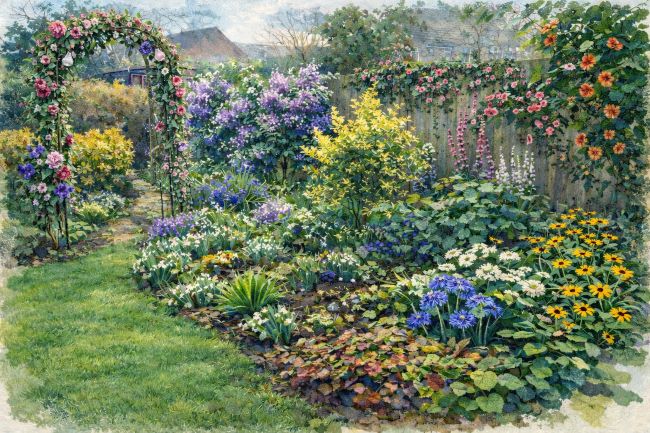
Side Border Illustration
Overall Philosophy – Restoration Over Renovation
Core Principle
This is a restoration project, not a complete garden makeover. The goal is to roll the garden back to its condition before purchase – when it was well-maintained but not yet overgrown.
Why Not Start From Scratch?
The garden isn’t massively out of control. While it has become overgrown and certain aggressive plants have taken over, the bones of a good garden are still present. Starting from scratch would be:
- Wasteful – destroying established plants with years of growth
- Expensive – requiring complete replanting
- Time-consuming – setting you back 3-5 years while new plants establish
- Ecologically disruptive – removing habitat and soil structure that’s already developed
- The nuclear option – when targeted intervention is all that’s needed
What We’re Preserving
The existing garden contains valuable assets:
- Established plants (agapanthus, snowdrops, roses, daylilies, Helianthus)
- Mature structure (rose arches, quality fencing, established borders)
- Good soil that’s been built up over years
- An established design framework that works – it just needs editing
The Restoration Approach
Think of this as gardening by subtraction and refinement rather than addition:
- Edit, don’t erase – Remove only what’s problematic (polygonum, excess ivy, overcrowding)
- Enhance what works – Retrain roses, relocate good plants to better positions, add complementary planting
- Work gradually – Let solutions unfold over months (ivy die-back, mulch programme, seasonal planting)
- Respect the existing character – This garden has a history; we’re continuing its story, not starting a new book
The Patience Principle
This is anti-instant gratification gardening. Rather than the dramatic “before and after” transformation that’s popular on social media, this approach says:
- Good gardens evolve, they aren’t created overnight
- Working with what exists is more sustainable and satisfying
- Observation over time reveals what truly needs changing
- Gradual improvement allows you to learn the garden’s rhythms and correct course if needed
Guiding Questions for Every Decision
Before removing or changing anything, ask:
- “Is this plant/feature actually a problem, or just neglected?”
- “Can this be improved with editing rather than removal?”
- “Will I regret removing this in two years when it would have recovered?”
- “Am I being impatient, or is this genuinely beyond saving?”
Side Border Plan
Current Situation
- Recently tidied and cleared.
- Some areas taken over by polygonum.
- Ivy growing up the fence.
- Good structural plants already in place (snowdrops, daylilies, etc.).
Weed Control Strategy
Spot Treatment
- Use a strong mix of Roundup weed killer.
- Apply with:
- Small hand sprayer
- Weed stick for precision
- Treat weeds as they emerge rather than blanket spraying.
Polygonum
- Will be spot treated as shoots emerge between snowdrops.
- Should be manageable with persistence.
Ivy on Fence
- First job: spray ivy using a small hand sprayer.
- Allow it to die back over the next couple of months.
- Once dead, carefully tease it off the fence.
Fence Plan
- Fence is high-quality timber.
- Aim to repair rather than replace.
- Once ivy is removed, assess and repair as needed.
- Add climbers after ivy removal:
- Climbing roses
- Clematis ‘Jackmanii’ (Clematis germanii)
- Sweet peas (can be started now)
- Possibly dahlias
- Compost and feed climbers well
Planting & Repositioning
Foxgloves
- Move to the back of the border against the fence.
Existing Additions
- Agapanthus already planted.
- Lilac positioned near the rose arch.
Arch Area
- Retrain roses.
- Add additional climbers:
- Clematis ‘Jackmanii’
- Sweet peas
- Spray and tidy left-hand side beyond the arch.
- Keep some:
- Daylilies
- Hellebores (assuming “helicrescent”)
- Begin relocating these to spread colour throughout the garden.
Border Enhancements
To extend colour through the season, add:
- Asters
- Yellow Rudbeckia
- White chrysanthemums
Goal: Longer flowering season and better distribution of colour.
Mulching Plan
- Source cardboard (possibly a roll from eBay).
- Lay cardboard over cleared areas.
- Spread mulch on top.
- Suppress weeds gradually and improve soil.
- Ongoing, phased approach rather than doing everything at once.
Order of Work (Suggested)
- Buy Roundup.
- Spray ivy on fence.
- Spot treat polygonum and emerging weeds.
- Move foxgloves to fence line.
- Retrain roses on arch.
- Add new climbers.
- Lay cardboard.
- Mulch.
- Begin gradual plant redistribution.