This climbing hydrangea does not look happy
23 September 2026
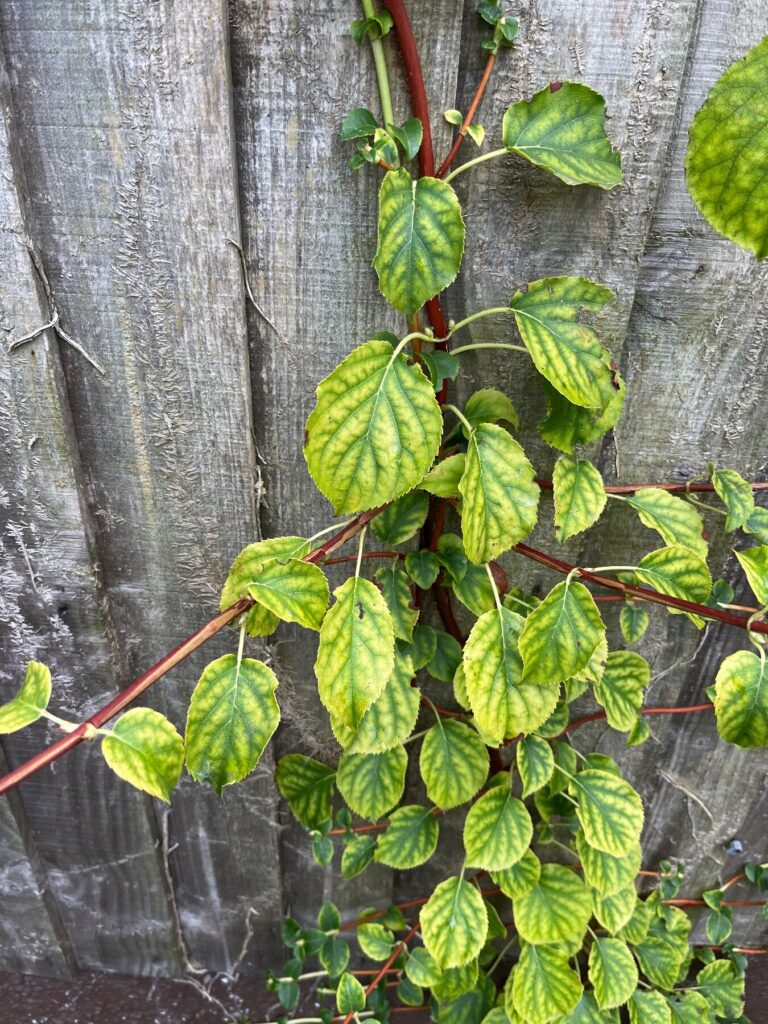
Yes — it’s definitely showing stress, but it looks **recoverable**.
From the photo the main symptom is **yellowing between the leaf veins while the veins stay greener**. That is classic **chlorosis**, usually caused by the plant being unable to take up nutrients properly — often **iron and/or magnesium** — rather than a straightforward disease.
## Most likely causes
### 1. Nutrient lock-up / slightly alkaline soil
Climbing hydrangeas prefer a **moist, humus-rich, slightly acidic to neutral soil**. If the soil is too alkaline, iron becomes unavailable and the leaves yellow like this.
This fits with GardenAdvice notes for your garden, which mention feeding acid-loving plants such as rhododendrons, azaleas and pieris if they show deficiency, and using Epsom salts for camellia and magnolia where needed .
### 2. Dry root conditions against the fence
Plants at the base of fences often sit in a **rain shadow**, so even when it rains the root area can stay dry. Hydrangeas dislike drying out, especially while establishing.
Your garden notes also highlight the value of mulch because it helps retain moisture, regulate soil temperature and improve soil quality .
### 3. Compacted or poor soil near the fence
If the soil is compacted, roots struggle to grow and water can run off rather than soak in. GardenAdvice notes specifically warn that compacted soil restricts roots and reduces water uptake .
### 4. Seasonal yellowing — but probably not just that
As it is late September, some yellowing is normal before leaf fall. However, the strong green-vein/yellow-leaf pattern suggests a deficiency or root-zone problem rather than simple autumn colour.
---
## What I’d do now
### 1. Water deeply
Give it a really good soak at the base — not a light sprinkle.
Aim for **one full watering can**, possibly two if the soil is dry, once or twice a week during dry spells.
### 2. Apply a liquid tonic
Use one of the following:
- **Sequestered iron / ericaceous plant tonic** — best if this is iron chlorosis.
- **Epsom salts** — useful if magnesium deficiency is involved. Use about **one tablespoon in a watering can**, applied around the roots.
Do not overdo fertiliser now; we are heading into autumn and we do not want to push too much soft new growth.
### 3. Mulch the root area
Add a 5–7 cm mulch around the base, but keep it away from the stem.
Good options:
- leaf mould
- well-rotted compost
- composted bark
- ericaceous compost as a top dressing
Avoid piling rich manure directly against the stem. If you have used **spent mushroom compost** nearby, be aware it can be alkaline, so I would not use that around this hydrangea while it is showing chlorosis.
### 4. Check the root zone
Gently scrape the soil surface around the base and check:
- Is it bone dry?
- Is the soil compacted?
- Is it planted too close to the fence panel?
- Is there rubble or builders’ waste under the soil?
- Are other shrubs or climbers competing with it?
If it is newly planted and the soil is poor, it may simply not have got its roots out properly yet.
---
## What to do in spring
In March/April:
- Feed with an **ericaceous shrub feed** or a balanced fertiliser.
- Reapply mulch.
- Keep watering during dry spells.
- If chlorosis returns, test the soil pH.
- Continue training the stems onto the fence/supports.
GardenAdvice notes also recommend regular seasonal feeding, with Growmore in spring or autumn and liquid tomato feed from March to October where appropriate, while noting that acid-loving plants may need specialist feeds .
## Do not prune it hard now
Only remove dead or damaged stems. Climbing hydrangeas can be slow to establish, and hard pruning now would add stress.
## Quick diagnosis
**Most likely:** chlorosis caused by dry/alkaline/compacted root conditions.
**Not likely:** a serious disease.
**Prognosis:** good, if the root area is improved and it is kept evenly moist.
I’d start with a deep water, sequestered iron or Epsom salts, and a good mulch. That should help stabilise it before winter.