Is this honey fungus
23 September 2026
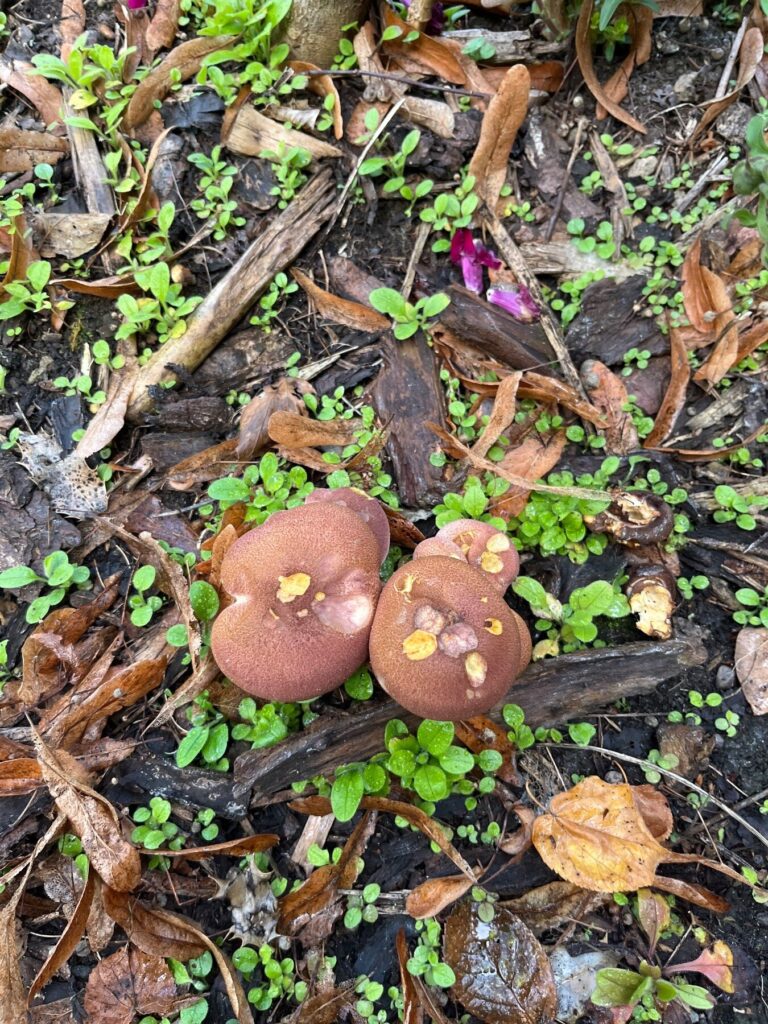
From the photo, **I don’t think this looks like classic honey fungus**.
It looks more like a **wood-rotting fungus growing from the woodchip/mulch** — possibly one of the harmless saprophytic fungi that appear in damp autumn weather. That is common where bark, woodchip, old roots or woody debris are present. Woodchip and bark mulches gradually break down and improve soil, so fungi appearing in them is often part of the normal decomposition process rather than a plant disease problem .
## Why it doesn’t look typical of honey fungus
Honey fungus usually has:
- **Honey-yellow to tan caps**, often in tight clusters
- A more obvious **stem with a ring**
- Pale/cream gills underneath
- Often appears at the **base of woody plants, stumps or roots**
- Often comes with signs of plant decline nearby
The mushrooms in your photo look **darker brown/purplish-brown**, rounded, and seem to be emerging from a mulched area rather than obviously from the base of a woody plant.
## Quick checks to be sure
Have a look for these honey fungus warning signs:
1. **Black “bootlace” strands**
These are black, cord-like fungal strands under bark, in soil, or around roots.
2. **White fungal sheets under bark**
If a nearby woody plant is dying, gently scrape a little bark near the base. Honey fungus often forms creamy-white sheets between bark and wood.
3. **Sudden dieback of shrubs or climbers**
Wilting, sparse growth, poor leaf colour and branch dieback can be symptoms.
4. **Mushrooms in dense clusters around a stump or shrub base**
That would be more suspicious than mushrooms scattered in mulch.
## What to do now
- **Remove these mushrooms** and put them in the bin, not the compost.
- **Do not eat them** — mushroom ID from a photo is not safe for edibility.
- Rake back the mulch slightly and check whether they are attached to **woodchip** or to a **woody root/stump**.
- If they are just on woodchip, it is probably not a major concern.
- If you find black bootlaces, white sheets under bark, or nearby plants declining, then we should treat it as possible honey fungus.
## My view
At this stage: **probably not honey fungus — more likely harmless mulch fungi**.
Given your garden has had mulching and soil improvement work, fungal growth in damp autumn conditions is quite normal. Mulch encourages soil life and helps retain moisture, though woody mulches can also produce mushrooms as they break down .
If you can send one more photo showing the **underside/gills and stem**, plus a wider shot showing what plant it is growing beside, I can give you a more confident answer.