How do I prune these hydrangeas
23 September 2026
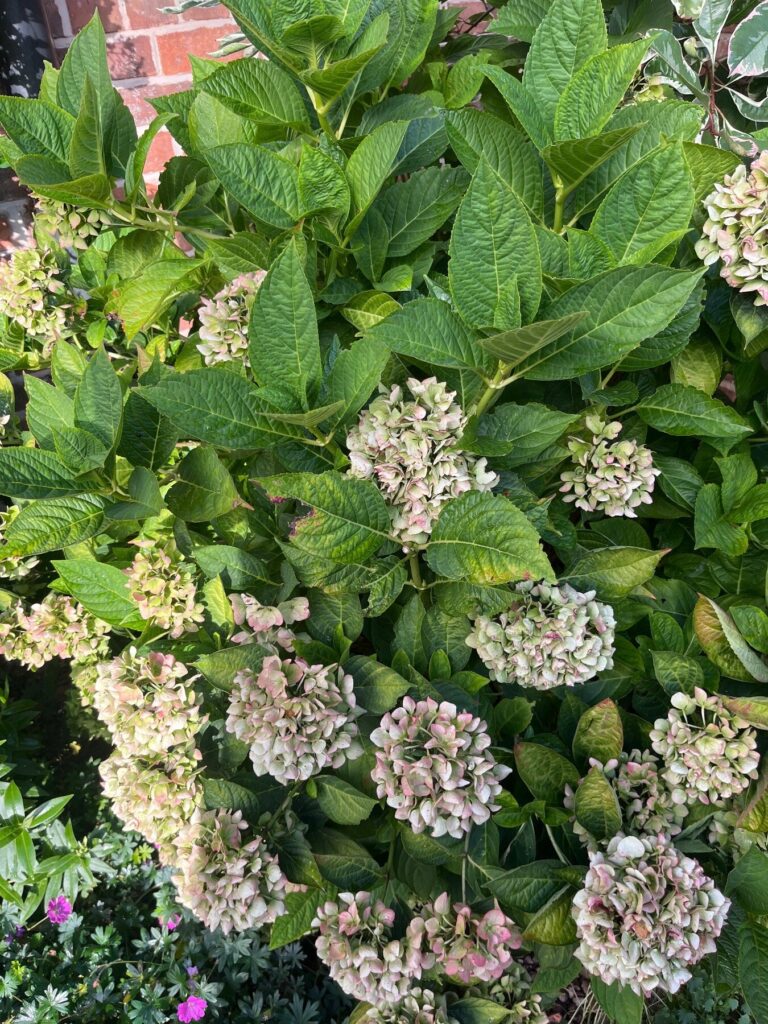
These look like **mophead hydrangeas — Hydrangea macrophylla**. They flower mostly on **old wood**, so the key rule is: **don’t cut them hard back now**, or you may remove next year’s flowers.
Your garden notes also mention cutting the hydrangeas back to **developing shoots when the weather improves**, so the main pruning should be done in **spring**, not hard in autumn/winter.
## What to do now — late September
For now, I would:
- **Leave most flower heads on the plant**
They give some winter protection to the buds below and look good with frost.
- **Only remove anything clearly dead, broken or diseased**
Cut those stems back to healthy wood or to the base.
- **Do not cut the strong green leafy shoots back**
These are likely to carry next year’s flower buds.
- **If the faded heads annoy you**, you can lightly deadhead a few by cutting just below the flower head, but avoid cutting down into the main stems.
## Main pruning — March to April
In spring, when the worst frosts have passed and you can see plump green buds:
1. **Remove each old flower head**
- Cut just above the first strong pair of healthy buds below the flower head.
- Usually this means only taking off the flower head and a short piece of stem.
2. **Cut out dead stems**
- Any stems with no swelling buds can be cut right down to the base.
3. **Thin the oldest stems**
- On a mature congested plant, remove about **one quarter to one third of the oldest woody stems** at ground level.
- This encourages fresh shoots from the base without sacrificing too many flowers.
4. **Shape lightly**
- If stems are crossing, weak or growing into the wall/path, remove them selectively.
- Avoid rounding the whole shrub over with shears.
## If they are too big
If these hydrangeas have outgrown the space, renovate them gradually:
- **Year 1:** remove one third of the oldest stems to the base.
- **Year 2:** remove another third.
- **Year 3:** finish thinning.
This keeps the plant flowering while reducing size over time. A hard cut all at once is possible, but it usually means **few or no flowers the following summer**.
## After pruning
In spring, give them:
- A mulch of well-rotted compost or manure around the base.
- A general feed such as Growmore.
- Regular watering in dry spells, especially as they’re close to the brick wall where soil can dry out quickly.
In short: **leave them mainly alone now, then in spring cut back to the first strong buds and remove old/dead stems from the base.** That will keep them healthy and flowering well.