Half Barrel Water Feature in Your Garden
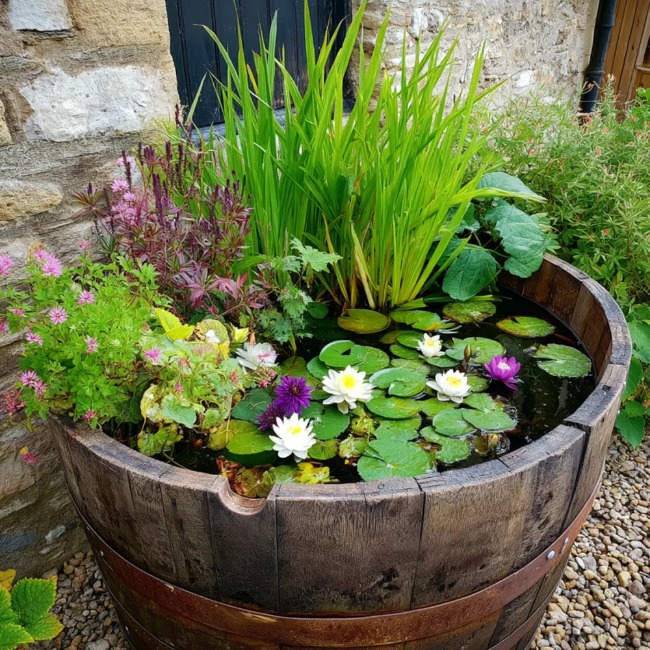
How to Create a Half Barrel Water Feature in Your Garden
A half barrel water feature is one of the most satisfying garden projects you can undertake. It requires no digging, no specialist equipment, and very little expense, yet the result is a genuine wildlife pond that will attract frogs, newts, dragonflies, and a host of beneficial insects within weeks of being filled. Whether you have a large garden or a modest patio, a well-planted half barrel brings the sights and sounds of water to any outdoor space.
Choosing and Preparing Your Barrel
Traditional oak half barrels are ideal — their thick staves retain moisture well and look beautiful in a garden setting. You can find them at most garden centres, reclamation yards, and online. Sizes vary but a standard half barrel holds around 100 to 150 litres, which is enough to support a good range of plants and wildlife.
Before filling, check the barrel for leaks. New barrels sometimes need soaking for a day or two to allow the wood to swell and seal. If yours leaks persistently, painting the interior with a proprietary pond sealant designed for wooden barrels will solve the problem — make sure it is aquatic-safe and allow it to cure fully before adding water or plants.
Position your barrel before filling it — once full it will be extremely heavy and almost impossible to move. Choose a spot that receives partial shade for at least part of the day; this is one of the most important decisions you will make, as we will explain below.
The Overheating Problem — and How to Solve It
The single biggest challenge with a half barrel water feature is overheating. Because the volume of water is small — typically 100 to 150 litres compared to thousands in a garden pond — the temperature can rise dramatically in hot sunny weather. Water that becomes too warm loses its oxygen rapidly, becomes stagnant, and turns green with algae. In extreme heat it can become hostile to the very wildlife you are trying to attract.
There are several ways to manage this problem, and using them in combination gives the best results.
Choose the right position
Avoid positioning the barrel in full sun all day. A spot that receives morning sun and afternoon shade is ideal. The shade from a nearby shrub, fence, or wall can make a significant difference to water temperature through a summer afternoon.
Plant oxygenating plants generously
This is the most effective solution of all. Oxygenating plants work in two vital ways — they absorb nutrients that algae would otherwise feed on, and they release oxygen directly into the water, maintaining water quality even when temperatures rise. In a small barrel, plant generously rather than sparingly.
The best oxygenating plants for a half barrel include:
- Canadian pondweed (Elodea canadensis) — The classic oxygenator, vigorous, effective, and widely available. Simply drop weighted bunches into the water. It will establish quickly and get to work immediately.
- Hornwort (Ceratophyllum demersum) — Excellent for small water features, floats freely without needing to root, and is very effective at clearing green water. More tolerant of shade than most oxygenators.
- Water starwort (Callitriche stagnalis) — A native British plant, excellent for wildlife, grows well in the shallower water of a barrel, and produces surface rosettes that look attractive.
- Curly waterweed (Lagarosiphon major) — Fast-growing and highly effective, produces dense underwater growth that both oxygenates and provides shelter for invertebrates.
Aim to have oxygenating plants covering roughly a third to a half of the water surface area. In the first season be prepared to thin them out as they establish — this is a sign they are working well.
Use surface cover plants
Floating leaves on the water surface shade the water beneath, reducing temperature and discouraging algae. A well-chosen water lily does this beautifully — more on that below. As a rule of thumb, aim to have around a third to a half of the water surface covered by floating leaves through summer.
Top up regularly
Evaporation from a small water feature can be significant in hot weather, reducing the volume further and concentrating any nutrients in the water. Top up with rainwater where possible — collected from a water butt — rather than tap water, which contains chlorine and minerals that can encourage algae growth.
Water Lilies — the Perfect Half Barrel Plant
A half barrel is a wonderful home for a water lily, and seeing the first blooms open on the water surface is one of the great pleasures of the garden. However, choosing the right variety is essential. Most water lilies are bred for large ponds and will quickly overwhelm a small container, producing masses of leaves but few flowers and choking out everything else.
The key measurement is planting depth — water lilies are planted in aquatic baskets on the floor of the container, and the depth of water above the crown of the plant needs to match the variety’s requirements. A standard half barrel offers a water depth of around 30 to 45cm, so you need varieties specifically suited to shallow water.
Best water lilies for a half barrel:
- Nymphaea ‘Pygmaea Helvola’ — One of the finest miniature water lilies available. Soft yellow flowers with orange stamens, ideal planting depth of 15 to 30cm. Will not overwhelm a barrel and flowers freely all summer.
- Nymphaea ‘Pygmaea Rubra’ — Deep rose-red flowers, similar compact habit to Helvola, ideal for shallow containers. Flowers over a very long season.
- Nymphaea ‘Laydekeri Lilacea’ — Soft lilac-pink flowers, slightly larger than the pygmaea types but still well suited to a barrel at 20 to 35cm depth. Very free-flowering.
- Nymphaea ‘Aurora’ — Unusual chameleon-like flowers that open yellow and deepen through orange to red as they age. Shallow planting depth of 15 to 25cm makes it ideal.
- Nymphaea ‘Froebeli’ — Deep wine-red flowers on a compact plant, one of the most reliable performers in shallow containers, planting depth 20 to 40cm.
Plant your water lily in a proper aquatic basket using aquatic compost, top with a layer of pea gravel to prevent the compost floating out, and lower carefully into position. In the first weeks you can raise the basket on bricks to bring the crown closer to the surface, then lower it gradually as the plant establishes.
Creating Access for Frogs, Newts, and Wildlife
One of the most important — and most often overlooked — aspects of a half barrel water feature is providing access and escape routes for wildlife. Frogs, toads, newts, and hedgehogs can all drown in a barrel if they cannot get out. The smooth sides of a barrel offer no grip and the rim is too high to climb.
There are several simple ways to solve this:
- A pebble beach ramp — Stack large pebbles or cobbles at one side of the barrel, building them up from the floor of the barrel to just above the waterline and continuing over the rim. This creates a gentle slope that any small creature can climb. It also provides a spot where birds and insects can drink safely.
- A piece of rough timber — A short length of untreated timber or driftwood leaning from the water surface to the ground outside the barrel works well and looks natural.
- Marginal plants cascading over the edge — Planting a marginal such as brooklime or water mint so that it trails over the rim creates a natural bridge for insects and small amphibians.
- Position at ground level — If possible, sink the barrel partially into the ground or build up the surrounding soil so the water surface is close to ground level. This makes access and escape straightforward for frogs, toads, and hedgehogs.
Once wildlife starts visiting — and it will, often within days of the barrel being filled — you will see just how valuable even a small water feature is. Frogs are particularly welcome as they consume large numbers of slugs and other garden pests.
Marginal Plants for the Barrel Edge
As well as oxygenators and a water lily, adding one or two marginal plants completes the planting scheme and makes the barrel look more naturalistic. Choose compact varieties suited to shallow water — around 5 to 15cm depth — and plant in aquatic baskets on a shelf of bricks inside the barrel.
Good choices include:
- Dwarf bulrush (Typha minima) — The only bulrush truly suited to a small container, producing its characteristic brown bobbles on compact plants.
- Water mint (Mentha aquatica) — Fragrant, attractive to pollinators, and useful as a wildlife access plant trailing over the rim.
- Brooklime (Veronica beccabunga) — Native, produces small blue flowers, excellent for wildlife, and naturally trails over the edge.
- Marsh marigold (Caltha palustris) — Brilliant yellow flowers very early in spring, one of the first nectar sources of the year for pollinators.
Ongoing Care
A well-planted half barrel requires surprisingly little maintenance. Remove blanketweed by hand if it appears — twisting it around a cane works well — and thin oxygenating plants in late summer if they have become very dense. Cut back marginal plants in autumn and remove any fallen leaves promptly as they decompose and reduce water quality. Top up the water level regularly through summer using rainwater where possible.
A half barrel water feature planted well in June will be established and teeming with life by August, and will continue to give pleasure — and vital habitat — for many years to come.