Restoring Garden Border Soils before Replanting
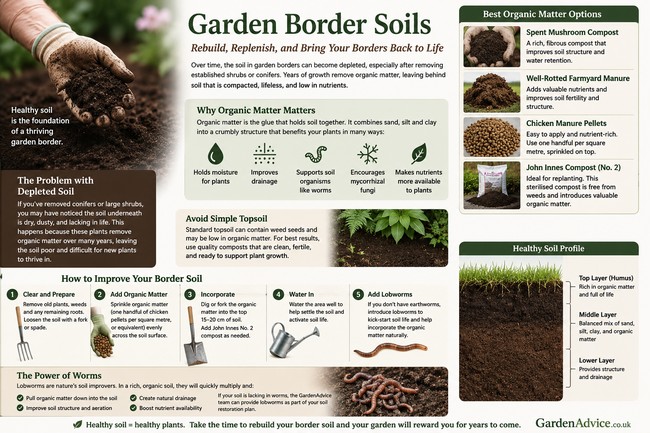
Download Guide on restoring gardeb border soils
How to rebuild organic matter and bring tired garden soil back to life
When replanting an established garden border, or simply adding new plants to an existing border, one of the most important things to consider is the condition of the soil.
Over many years, established shrubs, trees and other plants can leave the surrounding soil depleted of organic matter. This is particularly noticeable when removing old conifers, including Leyland cypress, where the soil underneath can sometimes appear extremely dry, dusty and almost lifeless.
Simply removing the old plants and putting new ones into the same unimproved soil can make it much harder for the new planting to establish successfully.
The answer is to rebuild the organic content of the soil and encourage it to become a healthy, living soil again.
Why Organic Matter Is So Important
A good garden soil contains a mixture of mineral particles—principally sand, silt and clay—together with organic matter, water, air and a huge community of living organisms.
As organic material decomposes, it contributes to the formation of humus and helps create a more stable and effective soil structure.
Increasing organic matter can help the soil to:
- Hold useful moisture for plant roots.
- Improve drainage and aeration.
- Create a better structure for root development.
- Support earthworms and other beneficial soil organisms.
- Encourage conditions in which beneficial mycorrhizal fungi can thrive.
- Hold and cycle nutrients, making them more readily available to plants.
This is why adding fertiliser alone is not always enough.
Fertiliser supplies nutrients, but organic matter helps improve the soil itself.
The Problem After Removing Established Shrubs and Conifers
If you have ever dug out an old conifer hedge or a large established shrub, you may have noticed just how poor the soil can appear underneath.
The soil may be dry, dusty, compacted and full of old roots.
Large established plants have spent many years competing for moisture and nutrients, while fallen organic material may have been routinely removed from the border rather than allowed to return to the soil.
Conifers can create particularly challenging conditions because of their dense root systems and the dry conditions commonly found beneath established plants.
Once the plants have been removed, it provides an ideal opportunity to restore the soil before replanting.
What Organic Matter Can You Add?
There are several useful materials that can be used when regenerating a garden border.
Spent Mushroom Compost
Spent mushroom compost is an excellent general soil improver for many garden situations.
It adds organic material and can help improve both moisture retention and soil structure.
However, because it can be alkaline, it may not be the best choice around strongly acid-loving plants such as rhododendrons, azaleas and some other ericaceous plants.
Well-Rotted Farmyard Manure
Well-rotted farmyard manure is another excellent source of organic matter.
It can be particularly useful when regenerating tired soils before establishing new shrubs, roses and perennial planting.
Always use manure that has been properly composted or well rotted rather than fresh manure directly around new plant roots.
Pelleted Chicken Manure
The GardenAdvice team often use pelleted chicken manure because it is convenient, easy to handle and simple to spread evenly over an existing border.
As a general GardenAdvice approach, approximately one handful per square metre can be sprinkled evenly over the soil surface where appropriate.
Do not place a concentrated handful directly against the roots or crown of an individual plant.
The aim is to spread it across the soil so that nutrients become available throughout the rooting area.
Remember that chicken manure pellets are primarily a concentrated organic fertiliser rather than a bulky soil conditioner, so where the soil is seriously depleted they are best used alongside materials that physically add more organic matter to the soil.
One note on Pelleted Chicken Manure is that most dogs love to eat this from a border so whilst it does not do them any harm in small quanities its a good idea to lightly fork in and water well after application.
Adding John Innes Compost When Replanting
After removing large shrubs or conifers, you may also need additional material to replace soil levels or improve the immediate planting area.
For relatively modest additions, the GardenAdvice team often find a soil-based compost such as John Innes No. 2 useful.
It provides a consistent growing medium that can be incorporated with the existing garden soil when preparing an area for new planting.
Bringing in unknown topsoil can sometimes introduce unwanted weed seeds or perennial weeds, so if you do need substantial quantities of topsoil, always obtain good-quality screened soil from a reputable supplier.
John Innes No. 2 should not, however, be regarded as a direct replacement for bulk topsoil if you need to replace a significant depth or volume of soil.
Don’t Forget the Worms
Once organic matter has been added, it is worth checking the biological health of the soil.
One simple indication is the presence of earthworms.
Of particular interest are the larger, deep-burrowing earthworms commonly known as lobworms.
These worms create permanent vertical burrows and often come to the surface to collect organic material, which they pull down into the soil.
In a healthy soil with a good supply of organic matter, earthworms can play an important role in naturally incorporating organic material.
Their activity helps to:
- Move organic material deeper into the soil.
- Improve soil structure.
- Create channels for air and water.
- Improve natural drainage.
- Encourage nutrient cycling.
- Create better conditions for plant roots and other soil organisms.
Rather than repeatedly digging and disturbing an improving soil, it is often better to encourage the natural soil ecosystem to do much of this work for you.
If a MyGardenTeam member has a border with very poor biological activity or few earthworms, the GardenAdvice team can advise on the best way to restore the soil and encourage a healthier soil ecosystem.
A Simple GardenAdvice Method for Restoring a Tired Border
When renovating and replanting an established garden border:
- Remove unwanted shrubs, conifers and as much of the major old root system as practical.
- Remove perennial weeds before adding new compost or planting.
- Loosen heavily compacted soil without unnecessarily pulverising or repeatedly turning it over.
- Add suitable organic matter such as spent mushroom compost or well-rotted farmyard manure.
- Where appropriate, sprinkle pelleted chicken manure over the soil at approximately one handful per square metre, rather than concentrating it around individual roots.
- If modest additional soil volume is required, consider incorporating a soil-based compost such as John Innes No. 2.
- Plant into the improved soil and water thoroughly.
- Apply an organic mulch over the soil surface to help conserve moisture and continue feeding the soil ecosystem.
- Encourage earthworms and other soil organisms to gradually incorporate organic material and improve the soil naturally.
Think of Soil as a Living System
The key point is that good garden soil is much more than something that simply holds a plant upright.
Healthy soil is a living system.
Mineral particles, organic matter, roots, fungi, bacteria, earthworms and countless other organisms all interact to create the conditions plants need to thrive.
When renovating an old border, particularly after removing established shrubs or conifers, taking the time to rebuild the organic matter can make an enormous difference to the success of the new planting.
Instead of simply feeding the new plants, feed and rebuild the soil first.
Create a healthy soil and, in turn, you create the foundations for a healthy garden border.